

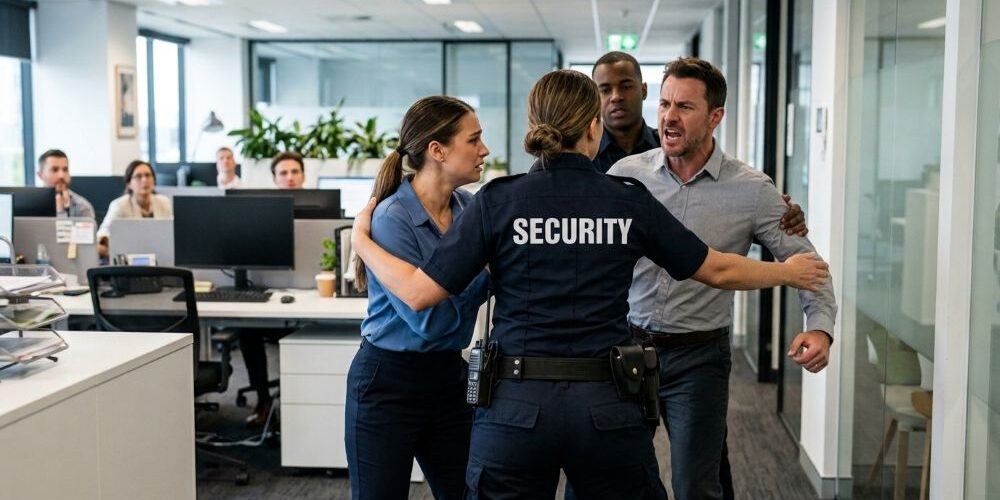
Security guards are one of the most effective frontline tools in workplace violence prevention, creating visible deterrents and rapid response capabilities that protect your staff. When you invest in professional security services, you’re building a structured defense that addresses threats before they escalate into emergencies.
Table of Contents
Why Workplace Violence Is a Serious Business Risk
The Role of Security Guards in Deterrence
Access Control and Threat Assessment
De-escalation and Emergency Response
Technology and Security Working Together
Choosing the Right Security Service for Your Workplace
Key Takeaways
- Trained security guards act as both a visual deterrent and an active response team in high-risk situations.
- Access control managed by security personnel significantly limits unauthorized entry and potential threats.
- De-escalation training allows guards to resolve conflicts before they turn violent.
- Technology, such as surveillance cameras and alarm systems, works best when paired with on-site security staff.
- Professional security services like Instaguard Security Services offer customized protection plans based on your specific workplace environment.
- Federal resources from OSHA’s workplace violence guidelines provide a legal and operational framework every employer should understand.
Why Workplace Violence Is a Serious Business Risk
Workplace violence affects businesses across every industry, from retail and healthcare to corporate offices and warehouses. According to OSHA, workplace violence is any act or threat of physical violence, harassment, intimidation, or other threatening disruptive behavior that occurs at the work site. It can range from verbal threats to physical assaults and, in the most severe cases, homicide.
The impact reaches far beyond the immediate incident. When employees feel unsafe, morale drops, absenteeism rises, and turnover accelerates. Legal liability for employers who fail to provide a reasonably safe work environment can be substantial under federal and state occupational safety laws. The National Institute for Occupational Safety and Health (NIOSH) identifies certain industries, including healthcare, late-night retail, and social services, as particularly high-risk.
Understanding this risk is step one. Acting on it, with a real prevention strategy that includes trained security personnel, is step two.
The Role of Security Guards in Deterrence
The presence of a uniformed security guard is one of the simplest and most powerful deterrents to workplace violence. Most individuals who intend to cause harm will reconsider their actions when they see a trained professional on-site. This visibility is not cosmetic; it signals that your organization takes security seriously and has systems in place to respond.
Security guards from a reputable service like Instaguard Security Services are trained to observe behavioral cues that average employees may not notice. These can include someone pacing near an entrance, making aggressive statements to staff, or attempting to enter restricted areas without authorization. Early identification of these warning signs gives your team the critical window needed to prevent an incident rather than simply react to one.
| Security Measure | How It Prevents Workplace Violence |
| Uniformed presence at entry points | Deters unauthorized or hostile individuals from entering |
| Regular patrols of the premises | Identifies and addresses suspicious behavior proactively |
| Coordination with management | Ensures guards know active threats or persons of concern |
| Incident documentation | Creates records that support HR and legal processes |
| Communication with local law enforcement | Speeds up response time during escalating situations |
Access Control and Threat Assessment
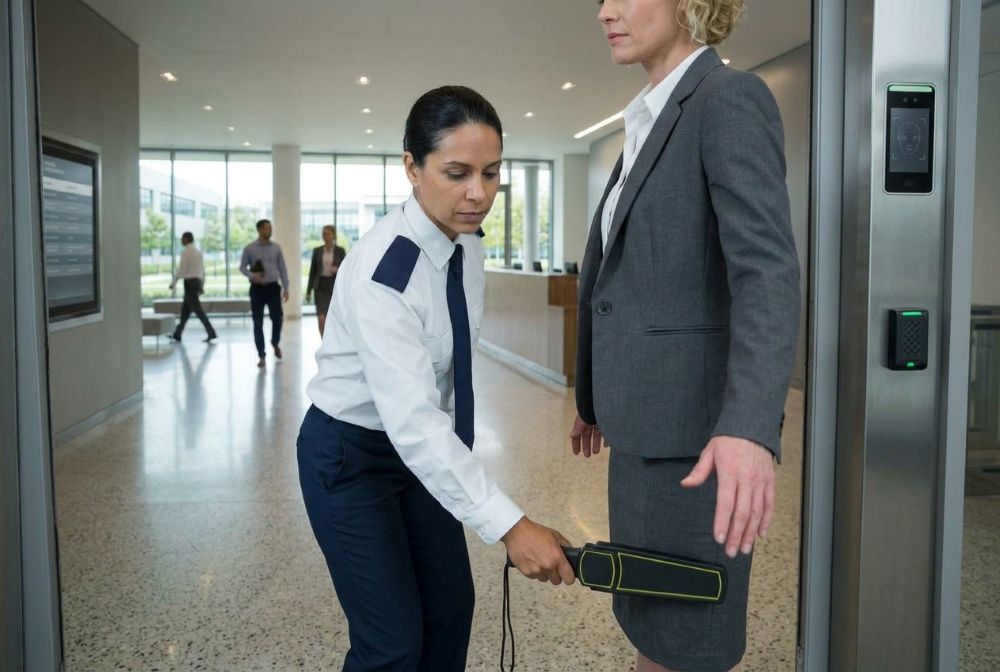
One of the most practical ways security guards protect employees is through strict access control. Controlling who enters your facility, and when, removes a significant category of threat before it ever reaches your staff.
Guards posted at entrances verify credentials, check visitor identification, and enforce sign-in protocols. This is particularly important in office buildings, healthcare facilities, and warehouses where multiple vendors, contractors, and visitors move through daily. Without a trained guard managing that entry point, access control becomes inconsistent and easy to bypass.
Beyond physical access, professional security services conduct ongoing threat assessments. Guards are trained to communicate with management about individuals who have made prior threats, recently terminated employees who may pose a risk, or any pattern of behavior that suggests a brewing conflict. The FBI’s resources on workplace violence highlight that many incidents are preceded by observable warning signs, which trained security personnel are specifically prepared to catch.
Instaguard Security Services works directly with your HR and management teams to ensure guards understand the specific threat landscape of your facility. That kind of customized approach is what separates a professional security service from a one-size-fits-all solution.
De-escalation and Emergency Response
Prevention is always preferable, but when a situation does begin to escalate, your guards need to respond effectively and fast. De-escalation training is a core part of professional security guard preparation, and it is one of the most underappreciated tools in workplace violence prevention.
De-escalation involves verbal and non-verbal techniques to calm an agitated individual before they become violent. A trained guard knows how to position themselves, what tone of voice to use, and which phrases tend to defuse rather than inflame a tense situation. These skills are not automatic; they come from structured training and regular practice.
When de-escalation is not enough, guards are also trained in emergency response protocols, including how to coordinate with local law enforcement, secure evacuation routes, and protect employees in a lockdown scenario. The Department of Homeland Security’s active shooter preparedness resources offer guidance on how businesses should integrate these protocols into their broader security plans.
Having Instaguard Security Services on-site means your employees do not have to figure out any of this on their own during a crisis. That responsibility sits with trained professionals.
Technology and Security Working Together
Modern security is not just about physical presence. Technology plays a supporting role that significantly amplifies what on-site guards can accomplish. Surveillance cameras, access card systems, alarm systems, and intercoms all contribute to a more complete security environment, but they require human oversight to be truly effective.
A camera system with no one monitoring it in real time is a documentation tool, not a prevention tool. Guards trained to actively monitor live feeds, review access logs, and respond to triggered alarms can turn passive technology into active protection. The Security Industry Association regularly publishes research on how integrated security systems outperform technology-only or personnel-only approaches.
When you work with a professional security service, the guards assigned to your facility understand how to operate and interpret the technology in place. That integrated approach closes the gaps that isolated systems leave open.
Choosing the Right Security Service for Your Workplace
Not all security services offer the same level of professionalism, training, or customization. When evaluating your options, look for a provider that conducts thorough background checks on guards, provides documented training programs, and has experience in your specific industry.
Ask potential providers about their incident reporting process, how they handle communication with your HR department, and what protocols are in place for emergency escalation. A provider that struggles to answer these questions clearly is likely not the right fit.
Instaguard Security Services brings structured professionalism to every engagement, offering guard services tailored to the specific needs of each client’s workplace. Whether you operate a single location or multiple sites, a consistent and reliable security presence is something your employees notice and appreciate.

Frequently Asked Questions
Q: What types of businesses benefit most from professional security guards?
Any business where employees interact with the public, handle cash, or operate in high-traffic environments benefits significantly from on-site security.
Healthcare facilities, retail stores, corporate campuses, warehouses, and schools are among the most common environments. However, even smaller offices with specific threat concerns, such as a history of client confrontations, should consider professional security services.
Q: How quickly can a security guard respond to an incident?
On-site guards can respond within seconds, compared to local law enforcement response times that may range from several minutes to longer depending on location.
That immediate presence is one of the primary reasons businesses invest in physical security personnel rather than relying solely on alarms or cameras.
Q: Can security guards legally detain someone at a workplace?
Security guards have limited legal authority, which varies by state, but they can generally detain someone using reasonable force until law enforcement arrives.
They are not law enforcement officers and cannot make arrests in the same legal capacity. Your security provider should clearly explain what guards are and are not authorized to do under applicable state law.
Q: What is the difference between armed and unarmed security guards?
Armed guards carry a licensed firearm and are typically deployed in higher-risk environments, while unarmed guards rely on training, presence, and communication skills.
The right choice depends on your industry, threat assessment, and the comfort level of your employees and clients. A professional security service can help you evaluate which option fits your situation.
Q: How do security guards support HR during workplace conflict situations?
Guards can document incidents, provide witness statements, and ensure physical safety during terminations or disciplinary meetings that carry a potential risk of conflict.
This collaboration between security and HR is a practical and often overlooked benefit of having professional security on-site.
The Importance of Security Guards in Workplace Violence Prevention
Workplace violence prevention is not a passive process. It requires active planning, the right personnel, and a security partner who understands your environment. Security guards provide the visible deterrence, access control, de-escalation capability, and emergency response that no policy document or camera system can replicate on its own.
If you are ready to build a safer work environment, reaching out to a professional security service like Instaguard Security Services is a direct and effective first step. Evaluate your current security posture, identify your highest-risk entry points and scenarios, and make sure your employees know someone has their back.
READ MORE: How to Conduct a Security Risk Assessment for Your Business in 2026
This content is for informational purposes only and is not legal, insurance, or compliance advice. California security licensing requirements and regulations may change. For a tailored security assessment or to confirm current service options, contact Instaguard Security at (800) 786-0698 or visit instaguardinc.com.