

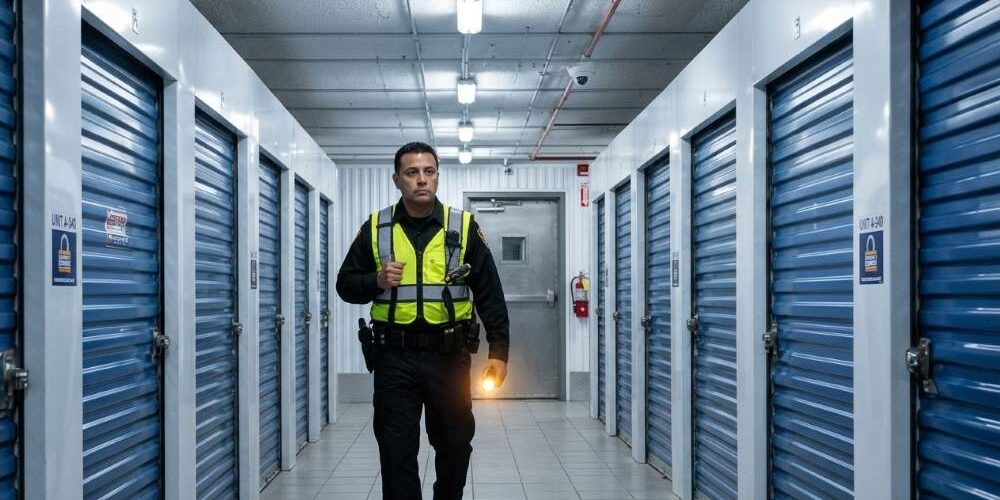
Self-storage facilities face a specific and persistent theft problem: units hold high-value property with minimal on-site supervision during off-hours. Security guards address that gap directly, providing human judgment, real-time response, and a visible deterrent that cameras and padlocks alone cannot replicate.
Physical security measures like cameras, gate codes, and alarms form the foundation of any storage facility’s protection plan, but they are passive. A guard notices the car that circles the lot three times without stopping. A camera just records it.
Who this is for: This article is written for self-storage facility owners and operations managers who are evaluating or upgrading their on-site security staffing, and for renters who want to understand what level of protection a facility actually provides before signing a lease. Not for: Residential homeowners or businesses looking for general security consulting unrelated to storage operations.
Key Takeaways
- Visible, uniformed guards are among the strongest theft deterrents a self-storage facility can deploy, reducing the likelihood of opportunistic break-ins.
- Guards provide real-time response that surveillance cameras and motion sensors cannot: they can stop, question, and report suspicious individuals before an incident escalates.
- Access control enforcement, including checking that gate codes match registered tenants, is one of the highest-value tasks a guard performs daily.
- Not every facility needs 24/7 armed personnel. Patrol schedules, post assignments, and armed versus unarmed staffing should align with the facility’s size, location, and crime data.
- Instaguard Security Services specializes in storage facility coverage, offering guard programs tailored to self-storage environments rather than generic commercial contracts.
- The trade-off with guard staffing is cost. Professional security coverage is an operating expense that must be weighed against the potential liability and reputational damage of an unaddressed theft incident.
What Guards Actually Do at a Self-Storage Facility
The role of a storage security guard is not the same as a guard posted at a retail store or office lobby. The environment is different. Self-storage facilities are spread across large footprints, often with hundreds of individual units across multiple corridors or outdoor rows. Foot patrols, vehicle patrols, and fixed post observation each serve a specific function.
A typical shift at a well-run facility might look like this: a guard performs a perimeter check at the start of each shift, logs any damage to unit doors or locks, verifies that the access gate is functioning correctly, and then rotates between a fixed observation post and scheduled patrols throughout the property.
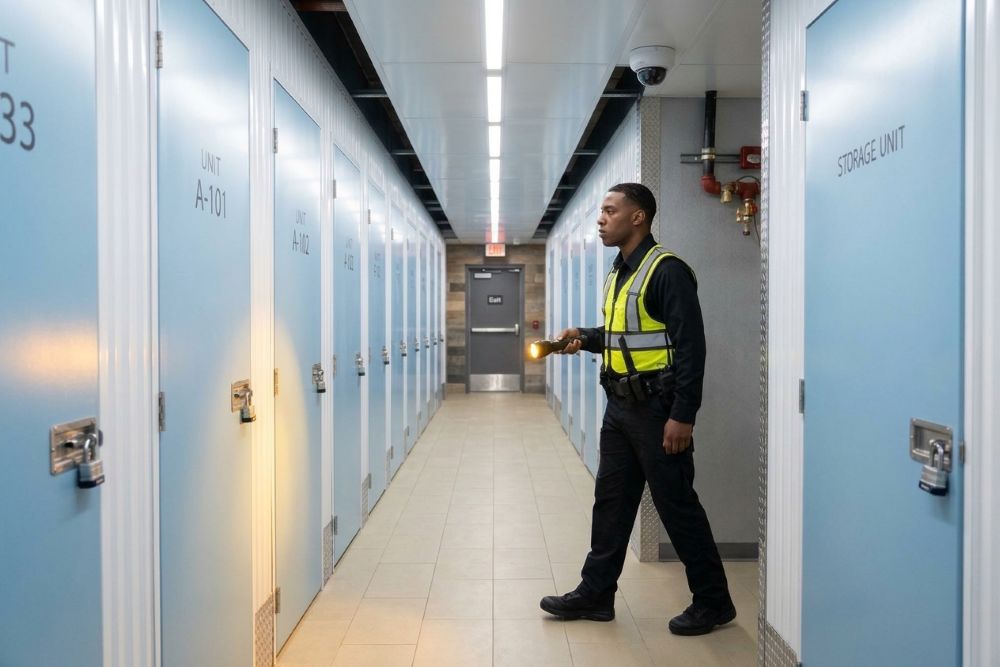
What usually trips operators up here is assuming that a single camera system covers the same ground as a guard. In practice, cameras have fixed fields of view. A guard walking the corridors can spot a tampered hasp, an unfamiliar vehicle parked in a row for an extended period, or a side fence that has been compromised. None of those observations require an incident to already be in progress.
Access control enforcement is where guards add immediate, measurable value. Tailgating at self-storage gates, where an unauthorized person follows a legitimate tenant through the gate before it closes, is one of the most common vectors for theft at these facilities. A guard stationed near the entrance can visually confirm that only authorized vehicles enter, which a gate code system cannot do on its own.
Instaguard Security Services structures its self-storage guard programs around this reality. Rather than assigning a standard commercial guard to a storage property, their approach emphasizes patrol patterns and access point coverage specific to the layout and peak-traffic hours of each facility they serve.
Armed vs. Unarmed Guards: Matching the Response to the Risk
Not every self-storage facility carries the same risk profile. A climate-controlled facility in a low-crime suburban zip code has different needs than an outdoor unit complex adjacent to a high-traffic commercial corridor with documented break-in history.
| Criteria | Armed Guard | Unarmed Guard |
| Deterrence level | High, especially for organized theft | Moderate, effective for opportunistic incidents |
| Cost (monthly, approximate) | Higher (varies by market and contract) | Lower, more accessible for smaller facilities |
| Response capability | Can intervene physically if trained and licensed | Observes, reports, and contacts law enforcement |
| Licensing requirements | State-specific armed security license required | Guard card or equivalent state certification |
| Best fit | High-value facilities, history of break-ins, 24/7 coverage | Daytime patrols, supplemental to camera/alarm systems |
The trade-off with armed guards is not just cost. Armed personnel require additional training, carry liability implications for the facility owner, and must hold current state-issued armed security licenses under Title 15 of the California Business and Professions Code or equivalent statutes in other states. In states like Texas, guards must be licensed through the Texas Department of Public Safety Private Security Bureau. Verify your state’s requirements before contracting.
For most mid-size self-storage operations, a combination of unarmed patrol guards during operating hours and monitored remote surveillance during overnight closures provides a practical, cost-effective baseline.

How Guard Patrols Complement Camera and Alarm Systems
Cameras do not prevent crime. They document it. That distinction matters significantly when you are trying to protect property rather than simply gather evidence after the fact.
The pattern seen most often at storage facilities that rely solely on technology is reactive security: a tenant reports a broken lock, the facility manager reviews the footage, law enforcement is contacted, and the property is already gone. Guards shift that model toward prevention by introducing unpredictability.
A consistent patrol schedule creates uncertainty for anyone casing the facility. If a potential thief cannot predict when a guard will appear in a given corridor, the risk calculus changes. That unpredictability is a genuine deterrent, and it is something no fixed camera can provide.
Alarm systems still matter. Motion-sensor lighting, perimeter alarms, and smart lock notifications are all useful layers. But they are most effective when there is a human on-site to respond to them in real time. A remote monitoring center receiving an alarm trigger at 2 a.m. will dispatch law enforcement, which can take 10 to 20 minutes in many urban markets. A guard on-site can investigate and act within seconds.
According to the FBI’s Uniform Crime Reporting program, burglary remains one of the most common property crimes across the United States. Self-storage facilities are a documented target category because of the perceived low oversight and high-value contents.
Instaguard Security Services incorporates alarm response protocols into their storage facility guard programs, so on-site personnel are trained to verify, respond, and document alarm events rather than simply wait for law enforcement to arrive.
Evaluating a Security Guard Contract for Your Facility
Before signing a guard services contract, storage facility operators should ask specific, pointed questions rather than accepting general assurances. The quality gap between security companies serving this niche is significant.
| Evaluation Criteria | What to Look For | Red Flag |
| Guard licensing | Active state guard card, verified by the operator | Company cannot provide license numbers on request |
| Training specifics | Storage-specific patrol training, incident reporting protocols | Generic commercial guard training only |
| Patrol documentation | Shift logs, digital patrol verification (GPS-tagged checkpoints) | No documentation system in place |
| Insurance coverage | General liability + workers’ comp naming your facility | Coverage limited to the guard company’s premises |
| Contract flexibility | Month-to-month or seasonal adjustment options | Long-term lock-in with no performance clause |
The Bureau of Labor Statistics Occupational Outlook Handbook for Security Guards confirms that training standards for security guards vary considerably by state and employer, which is exactly why asking for specifics matters. “We train all our guards” is not an answer. A specific curriculum, a named certification, or documented hours is.
One often-overlooked item in guard contracts is the substitution clause. When your assigned guard is sick or on vacation, who covers? Understaffed or improperly trained substitutes are a real operational gap. Confirm that the company maintains a bench of trained, facility-familiar backup personnel before committing.
Insurance is the other major consideration. A guard company that cannot provide a certificate of insurance naming your facility as an additional insured creates liability exposure for your business if an incident occurs during a shift.
Tenant Communication: What Renters Should Know About On-Site Security
If you are renting a storage unit rather than operating a facility, you have a legitimate interest in understanding what level of on-site security your monthly fee actually supports.
Most facility websites list security features in general terms: “24/7 video surveillance,” “electronic gate access,” “well-lit property.” Those are marketing descriptions, not operational guarantees. Before signing, ask specifically whether the facility employs on-site security personnel, what their hours of coverage are, and whether guards perform active patrols or simply occupy a booth at the entrance.
You can also check local incident reports. Many local police departments make crime data searchable by address or zip code. The City of Chicago’s data portal is one example of a US municipality that offers this kind of public access. Your local equivalent may provide useful context on how a specific facility’s address compares to nearby properties.
The trade-off for renters is straightforward: facilities with robust guard staffing typically charge more per square foot than those relying on camera-only systems. Whether that premium is worth it depends on what you are storing. Electronics, business inventory, collectibles, or firearms require a different calculus than seasonal furniture.
According to the Self Storage Association, the United States has more than 50,000 self-storage facilities operating nationwide, making it one of the most saturated and competitive segments in commercial real estate. That competition means some operators cut costs where tenants cannot easily see them, and security staffing is often the first line item reduced.
Understanding OSHA’s general duty requirements for workplace security can also be useful context for employees of storage facilities who feel their workplace lacks adequate safety measures.
Instaguard Security Services takes the position that security guards are not an optional add-on for self-storage operators. They are a core operational safeguard, one that protects property, reduces liability, and gives tenants the confidence to store high-value items without second-guessing their choice of facility.
YOU MAY ALSO LIKE: Retail Security and Loss Prevention: How Guards Reduce Shrinkage Across Every Store Format
Frequently Asked Questions
How many security guards does a self-storage facility typically need?
The right number depends on your facility’s size, layout, and operating hours, but most mid-size properties (200 to 400 units) function well with one guard per shift during open hours and remote monitoring overnight.
Larger facilities with multiple buildings, outdoor corridors, or high after-hours access traffic may need two guards to cover the footprint effectively. A site assessment from a company like Instaguard Security Services will identify blind spots in your current coverage before you commit to a staffing level. Starting with one guard and tracking incident frequency over 60 to 90 days gives you real data to justify adding personnel.
Do self-storage security guards need a license in the United States?
Yes. Every state that regulates private security, which covers the vast majority of U.S. states, requires guards to hold a current guard card or equivalent state-issued certification before working any paid security post.
Armed guards face an additional licensing layer, typically requiring a separate firearms permit issued by a state agency such as the Texas Department of Public Safety or the California Bureau of Security and Investigative Services. You should request the license numbers of any guards assigned to your facility and verify them directly with the issuing state agency. A reputable security company will hand over that documentation without hesitation.
What is the difference between a security guard and a security monitor at a storage facility?
A security guard is a trained, licensed individual physically present on the property who can observe, respond to, and document incidents in real time. A security monitor typically refers to a remote operator watching camera feeds from an off-site location.
The practical difference matters when something goes wrong. A remote monitor can call law enforcement, but response times in most U.S. urban markets run 10 to 20 minutes. A guard on-site can reach any point on the property in under two minutes, intervene before a unit is breached, and document the incident with firsthand detail. For high-value storage environments, remote monitoring works best as a supplement to on-site guards rather than a replacement.
Can a storage facility be held liable if a tenant’s property is stolen despite having a security guard on duty?
Liability depends on whether the facility met its duty of care, meaning whether it took reasonable steps to provide security and whether the guard company’s contract and insurance coverage were properly structured.
Facilities that employ guards through a licensed, insured security company and maintain documented patrol logs are in a significantly stronger legal position than those relying on verbal assurances of coverage. Courts have found storage operators liable for theft when advertised security measures were not actually in place. Review your guard services contract to confirm it includes general liability coverage naming your facility as an additional insured, and keep all shift documentation on file. Consulting a business attorney familiar with premises liability in your state is advisable before finalizing any security contract.
How do I know if the security guards at my storage facility are actually patrolling or just sitting at the entrance?
Ask the facility manager for patrol documentation, specifically GPS-tagged checkpoint logs or digital guard tour records that show when a guard visited each section of the property during a given shift.
Professional guard companies use guard tour systems that require personnel to scan checkpoints at fixed locations throughout the property, creating a timestamped record of every patrol. If a facility cannot produce that kind of documentation on request, you have no objective evidence that patrols are happening at the frequency advertised. In practice, the absence of a documented patrol system is one of the clearest signals that a facility’s security staffing is understaffed or poorly managed. Tenants storing high-value items should treat patrol documentation as a non-negotiable transparency standard before signing a lease.
The Bottom Line on Storage Facility Security: How Guards Protect Self-Storage Units
Guards bring something no technology can replicate: presence, judgment, and the ability to act before a loss occurs. For self-storage operators, the decision to staff qualified, properly trained guards is one of the clearest ways to protect both tenants and the business’s reputation.
If you operate a storage facility and have not formally reviewed your security staffing in the past 12 months, that review is the obvious next step. Contact Instaguard Security Services to request a site assessment specific to your facility’s layout, traffic patterns, and risk profile.
READ MORE: Office Building Security: Access Control, Lobby Guards & Best Practices
This content is for informational purposes only and is not legal, insurance, or compliance advice. California security licensing requirements and regulations may change. For a tailored security assessment or to confirm current service options, contact Instaguard Security at (800) 786-0698 or visit instaguardinc.com.