


Catalytic converter theft can be stopped, or at least made significantly harder, by combining physical deterrents with active parking lot security measures. The most effective approach layers anti-theft devices, environmental design, and trained security guard services to remove the easy opportunity criminals depend on.
Thieves target catalytic converters because the precious metals inside, primarily rhodium, palladium, and platinum, fetch hundreds of dollars per unit at scrap yards. A skilled thief with a battery-powered reciprocating saw can remove a converter in under 90 seconds. That speed is the core problem every parking lot operator needs to design around.
Who this is for: This article is written for parking lot managers, fleet operators, property managers, and business owners who need actionable strategies to protect vehicles on their premises from catalytic converter theft. Not for: Private homeowners looking to protect a single vehicle parked in a residential driveway; that situation calls for a different set of solutions with no shared-lot considerations.
Key Takeaways
- Thieves can remove a catalytic converter in under 90 seconds, so deterrence must start before they ever enter the lot.
- Physical anti-theft devices like CatClamp and Mil-Shield work best when combined with active security guard patrols, not used in isolation.
- Lighting is not optional. Poorly lit lots are the primary environmental condition that enables quick, undetected theft.
- Camera systems deter but rarely stop theft in real time; a monitored camera setup backed by a dispatcher changes that equation.
- Instaguard Security Services provides parking security patrols specifically structured to disrupt the window of opportunity thieves rely on.
- Reporting thefts to the National Insurance Crime Bureau builds the data record that supports law enforcement crackdowns.
Why Parking Lots Are Ground Zero for Converter Theft
Not all vehicles are hit equally, and not all lots carry the same risk. High-clearance vehicles, meaning trucks, SUVs, and vans, are targeted more frequently because thieves can slide underneath without a jack. Fleet lots, hospital parking structures, and big-box retail lots are particularly attractive because a high density of vehicles in one place allows a thief to select the easiest target and work quickly without standing out.
The National Insurance Crime Bureau has documented catalytic converter theft surging across major metropolitan areas. California, Texas, and Illinois consistently rank among the hardest-hit states, partly due to vehicle density and partly due to gaps in scrap metal dealer regulation. Texas, for example, only updated its metal recycling dealer regulations in the past few years to require photo identification for converter sales, but enforcement has been inconsistent in rural counties.
What makes parking lots specifically dangerous is the combination of factors: low foot traffic during off-hours, inconsistent lighting, and limited supervision. A thief casing a commercial lot knows that if no guard is present and cameras are pointed at entry points rather than the vehicle underbodies, the risk-reward calculation tips heavily in their favor.
The pattern Instaguard’s teams keep seeing is that operators invest in perimeter cameras and call it done. That covers one failure mode. It does nothing about the guy who walks in from a pedestrian entrance at 2 a.m. with a cordless saw.
| Parking Lot Risk Factor | Low Risk Profile | High Risk Profile |
| Lighting | Full LED coverage, no shadow zones | Partial or broken lighting, dark corners |
| Supervision | Active security guard patrol, 2-hour intervals or less | No guard presence, camera-only setup |
| Vehicle mix | Standard sedans, low clearance | Trucks, SUVs, hybrid fleet vehicles (Toyota Prius tops theft lists) |
| Access control | Gated entry, one entry point | Open lot, multiple pedestrian entry points |
| Neighborhood context | Well-patrolled commercial corridor | Industrial area, limited adjacent foot traffic |
Physical Deterrents Worth the Investment
Hardware solutions are the first line of defense for individual vehicles, and some of them genuinely work. The trade-off is cost and installation time per vehicle, which makes them most practical for fleet operators protecting a consistent set of vehicles rather than a general public lot.
CatClamp is one of the most widely installed anti-theft devices in the U.S. market. It uses aircraft-cable loops threaded through the converter and undercarriage to make cutting access extremely difficult. The catch is installation takes 30 to 60 minutes per vehicle and costs roughly $150 to $250 installed. For a 40-vehicle fleet, that adds up fast.
Mil-Shield plates are steel shields bolted over the converter housing. They are welded or bracketed to the vehicle frame, forcing any thief to cut through the shield before reaching the converter. Where this falls short: on older vehicles with rusted frames, proper anchoring is difficult and the product may not fit correctly.
Catalytic converter etching or marking is the lowest-cost option. Programs like the NICB’s VINalytics initiative and local police department engraving events mark converters with the vehicle’s VIN, making resale at scrap yards harder. California’s AB 1740, signed into law in 2022, required recyclers to reject converters without identifying marks. Other states are slowly following. The honest trade-off here is that marking alone does not prevent theft; it reduces resale value and helps with recovery.
For parking lot operators rather than fleet owners, the question is different. You cannot mandate that every vehicle entering your lot has a CatClamp installed. Your leverage is environmental and operational.
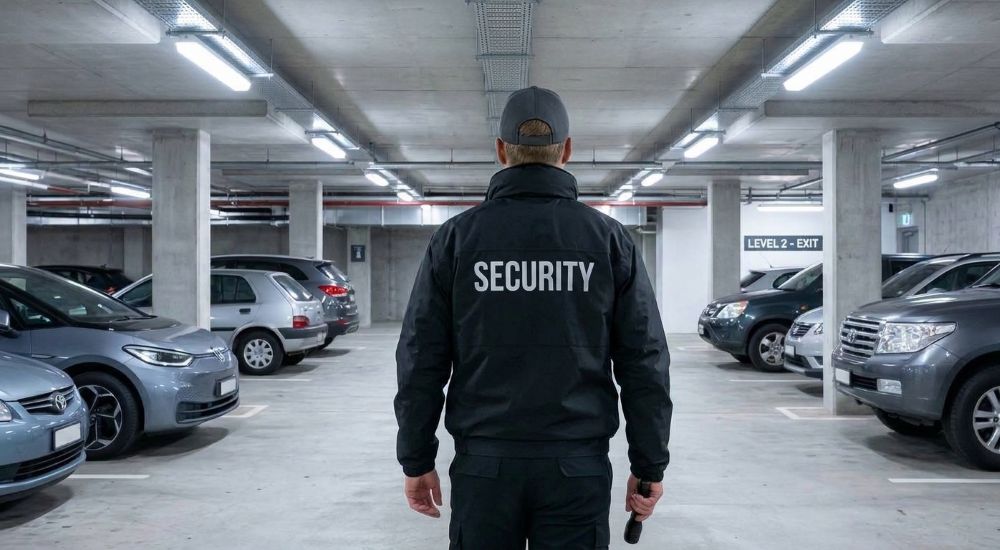
How Instaguard Parking Security Patrols Disrupt the Theft Window
The most significant variable in a thief’s calculation is: will someone see me? Physical deterrents raise the time cost. A visible security guard service raises the detection risk. Together, they make the lot a poor target.
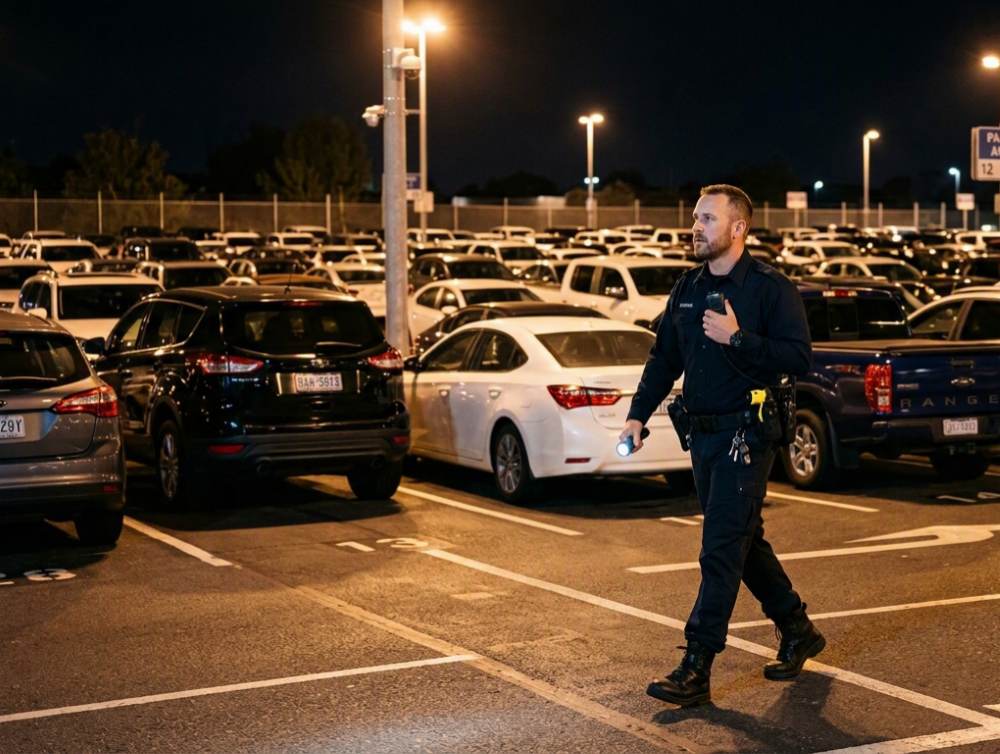
Instaguard Security Services structures parking security patrols around the theft window problem. Because a converter can be taken in under 90 seconds, a guard doing a standard 4-hour perimeter loop provides almost no real deterrence. The approach that works involves randomized patrol intervals, foot patrols through vehicle rows (not just perimeter walks), and active radio contact with a dispatcher who can respond to anomalies in real time.
What usually trips up operators here is assuming that a single guard standing at an entry booth covers the lot. Entry control and interior patrol are separate functions. A thief who knows the guard is stationary at the gate will simply enter from the other side of the lot.
Instaguard’s teams are also trained to recognize the pre-theft behaviors that are visible before a tool ever comes out: a vehicle idling near the lot exit, someone walking the lot without approaching a specific car, or a group arriving in an unmarked van during off-hours. Acting on those behavioral signals, by approaching and asking if the person needs assistance, breaks the cycle before the crime begins.
This is where a professional security service outperforms a camera system. Cameras document. Guards deter.
| Security Layer | Deterrence Effect | Response Capability | Cost Range (Monthly) | Best For |
| CCTV cameras only | Moderate (visible signage helps) | None in real time | $200 to $600 | Documentation, post-incident review |
| Remote video monitoring | Moderate to high | Dispatcher call to police | $400 to $1,200 | Unmanned sites with budget constraints |
| Security guard patrol (Instaguard) | High | On-site immediate response | $1,500 to $5,000+ | Commercial lots, fleet yards, hospital parking |
| Guard plus camera system | Very high | On-site plus video documentation | $2,000 to $6,000+ | High-value fleet lots, recurring theft targets |
Environmental Design Changes That Cost Less Than One Theft Claim
Before calling a security service, parking lot operators should audit their physical environment. Several changes carry a high deterrence-per-dollar ratio and reduce the baseline risk that even a well-staffed guard team has to manage.
Lighting upgrades are the highest-impact, lowest-recurring-cost investment. The U.S. Department of Justice’s CPTED (Crime Prevention Through Environmental Design) guidelines consistently show that adequate lighting reduces opportunistic property crime. Full LED coverage with no shadow zones, particularly in corners and along the low-visibility row ends, removes the cover thieves count on. A single converter theft on a fleet vehicle commonly generates an insurance claim of $1,500 to $3,000 after the converter replacement, labor, and O2 sensor damage are added up.
Signage works when it is specific. “This lot is patrolled by Instaguard Security Services” is more effective than a generic “security cameras in use” sign because it signals human presence and creates uncertainty about patrol timing.
Parking layout adjustments matter more than most operators realize. Organizing fleet vehicles so high-clearance trucks and hybrids park closest to active areas, such as building entrances, security stations, or well-lit central zones, pushes the easiest targets away from the low-visibility edges where theft typically occurs.
Reporting structures close the loop. Every theft or attempted theft should be reported to local law enforcement and also filed with the NICB’s online reporting tool so regional patterns get tracked. Some jurisdictions use this data to schedule targeted patrol increases in affected areas. The National Highway Traffic Safety Administration also maintains resources on vehicle theft trends that can inform your insurance and risk documentation.
The pattern that keeps showing up in lots that experience repeat thefts is that the first incident goes unreported beyond a police number. No NICB report, no internal incident log, no review of camera footage to identify the vehicle used. That data gap means the next theft is just as easy.
How to Stop Catalytic Converter Theft: Building a Layered Response Plan
Addressing how to stop catalytic converter theft at the parking lot level requires accepting that no single solution closes the gap. The approach that consistently reduces incidents combines three active layers working together.
Layer one is environmental control: full lighting coverage, access restriction where possible, and strategic parking layout. Layer two is hardware: catalytic converter protection devices on owned or fleet vehicles, with marked or etched converters at minimum. Layer three is human presence: a trained, professional security guard service running randomized interior patrols rather than stationary or perimeter-only coverage.
The Insurance Information Institute notes that comprehensive auto insurance covers catalytic converter theft, but repeated claims raise premiums and, in some fleet policies, trigger coverage reviews. The financial case for prevention is straightforward: the cost of a monthly Instaguard patrol contract typically runs less than two or three converter replacement claims.
Operators who implement all three layers and document the reduction in incidents also build a record that supports insurance negotiations. A demonstrable drop in claims after adding active security patrol is data an underwriter can use to justify a lower premium.
YOU MAY ALSO LIKE: Professional Parking Lot Security Guard Services: 24/7 Patrol and Monitoring That Protects Your Property
Frequently Asked Questions
Which vehicles are most commonly targeted for catalytic converter theft in parking lots?
Toyota Prius, Honda Element, and Ford F-Series trucks top the theft lists in the United States.
The Prius is targeted because its hybrid engine cycles between electric and gas power, meaning the converter sees less heat and retains higher concentrations of precious metals longer than converters on conventional vehicles. Ford F-Series and other full-size trucks are targeted simply because of ground clearance: a thief does not need a jack to slide underneath. If your lot hosts a significant number of these vehicles, treat them as your highest-priority protection concern and position them closest to active security zones.
Do anti-theft devices like CatClamp actually stop thieves, or just slow them down?
They slow thieves down enough that many will move on to an easier target, which is exactly the point.
No physical device is theft-proof, but the goal is not perfection. It is making your vehicle a worse option than the next one. A CatClamp adds several minutes of cutting time and creates noise. Combined with active parking security patrols from a service like Instaguard, that extra time and noise is often enough to trigger detection. The trade-off is that devices cost $150 to $250 per vehicle installed, so outfitting a large fleet is a significant upfront investment. For operators who cannot mandate devices on every vehicle, environmental and patrol-based controls carry more weight.
How does a security guard service actually prevent catalytic converter theft compared to cameras?
A guard can approach a suspicious person and break the pre-theft sequence before any tool comes out; a camera can only record after the fact.
Cameras are documentation tools. They matter for insurance claims, police reports, and identifying repeat offenders. But a thief who has cased a lot knows whether the cameras cover the undercarriage or just the entry point. A uniformed Instaguard officer walking randomized patrol routes through vehicle rows creates genuine uncertainty about when and where they will appear next. That unpredictability is what raises the perceived risk for a thief doing a quick calculation. The catch is that a stationary guard at a booth provides almost none of this benefit. Interior, randomized, on-foot patrol is what moves the needle.
Are parking lot owners or managers legally liable if a vehicle is stolen from their property?
In most U.S. states, parking lot operators are not automatically liable for vehicle theft, but liability can attach if negligence is proven.
Courts in several states have found operators liable when they advertised security features, such as cameras or guard patrols, that were not actually in place or were not functioning. If your signage says “monitored 24/7” and no monitoring is happening, that gap can become a legal exposure point. The safest position is to either deliver the security you advertise or update your signage to reflect actual conditions. Consulting a local attorney familiar with premises liability in your state is the right step if you have specific concerns, since laws vary significantly between California, Texas, Illinois, and other high-incident states.
What should a parking lot manager do immediately after a catalytic converter theft occurs on their property?
File a police report, review available camera footage, and report the incident to the NICB within 24 hours.
Beyond those immediate steps, pull your camera footage before it overwrites and preserve any still images that capture the suspect vehicle, license plate, or individuals involved. Share this with law enforcement proactively rather than waiting to be asked. File a report with the NICB’s online fraud and theft reporting tool so the incident enters regional tracking data. Internally, document the time, location within the lot, vehicle type, and any witness accounts. That record supports insurance processing for the affected vehicle owner and gives your security provider, whether Instaguard or another service, the specific location and time data needed to adjust patrol coverage for future prevention.
The Bottom Line on How to Stop Catalytic Converter Theft in Your Lot
How to stop catalytic converter theft is ultimately a question of layering: no single tool, device, or strategy closes the gap on its own. The lots that consistently see fewer incidents are the ones that combine full LED lighting coverage, hardware protection on high-risk vehicles, access control where feasible, and active human patrol through vehicle rows rather than just at entry points.
The cost of doing nothing is measurable. A single converter replacement claim runs $1,500 to $3,000 after parts, labor, and secondary sensor damage. A recurring theft pattern raises your tenants’ insurance premiums, damages your property’s reputation, and creates legal exposure if advertised security measures are not actually in place.
Your next step is a site assessment. Contact Instaguard Security Services to schedule a parking lot security review. An Instaguard team will walk your property, identify the specific lighting gaps, access vulnerabilities, and patrol coverage needs that apply to your lot, and build a security guard service plan structured around your hours, vehicle mix, and risk profile. Prevention costs less than one claim. Start there.
READ MORE: Storage Facility Security: How Guards Protect Self-Storage Units
This content is for informational purposes only and is not legal, insurance, or compliance advice. California security licensing requirements and regulations may change. For a tailored security assessment or to confirm current service options, contact Instaguard Security at (800) 786-0698 or visit instaguardinc.com.