

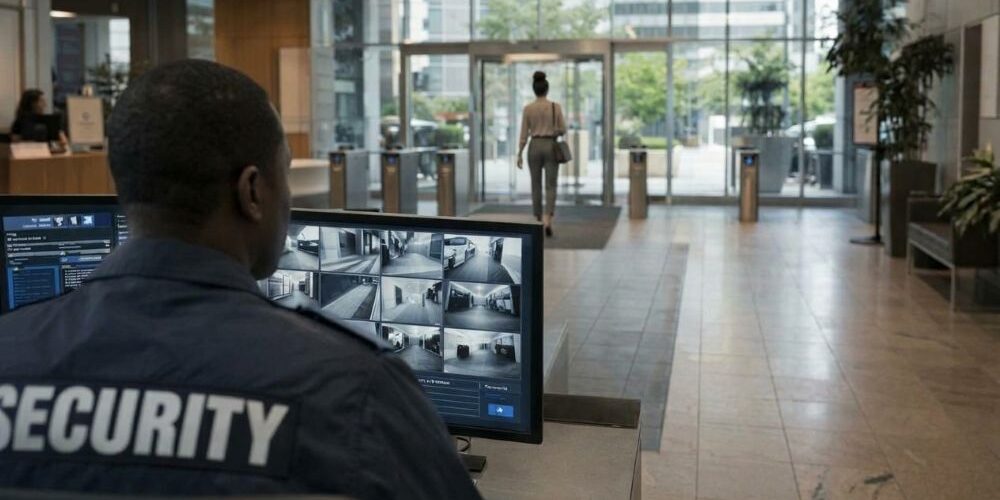
Effective office building security combines layered physical controls, trained personnel, and clear protocols to protect people, assets, and operations. When these elements work together, they dramatically reduce the risk of unauthorized access, theft, and workplace incidents.
Table of Contents
Why Office Buildings Are High-Value Security Targets
Access Control Systems: Your First Line of Defense
Lobby Guards: The Human Element That Technology Cannot Replace
Surveillance and Monitoring: Filling the Gaps
Visitor Management: Knowing Who Is in Your Building
Emergency Preparedness and Incident Response
Building a Security Culture Among Employees
Key Takeaways
- Layered security, combining access control, guards, and surveillance, is far more effective than any single measure alone.
- Lobby guards serve a dual purpose: deterrence and rapid human response to threats that cameras and card readers cannot handle.
- Modern access control systems offer granular permissions, audit trails, and remote management that older key-based systems cannot match.
- Visitor management protocols are a frequently overlooked vulnerability that sophisticated bad actors actively exploit.
- Employee security awareness is a force multiplier; an informed workforce spots and reports threats before they escalate.
- Regular security audits help you identify gaps before they become incidents, keeping your protocols current with evolving threats.
Why Office Buildings Are High-Value Security Targets
Office buildings concentrate valuable assets in one place. Sensitive data, expensive equipment, financial records, proprietary research, and large numbers of people are all present under a single roof. That combination makes commercial properties attractive targets for theft, corporate espionage, workplace violence, and opportunistic crime.
The threat landscape is not limited to outsiders. Insider threats, whether from disgruntled employees, contractors, or vendors, represent a significant portion of security incidents in corporate environments. The Cybersecurity and Infrastructure Security Agency (CISA) notes that physical security failures are often the entry point for broader attacks on an organization.
Multi-tenant buildings carry additional complexity. When dozens of companies share a single address, you have overlapping visitor populations, varying security cultures, and shared common areas that are difficult to control. This is why building owners and facility managers need a proactive, structured approach rather than a reactive one.
The consequences of inadequate security are real: equipment theft, data breaches stemming from unauthorized physical access, injuries from workplace violence, and serious liability exposure. Insurance carriers are increasingly scrutinizing physical security measures when underwriting commercial property policies, meaning weak protocols can affect your premiums in a direct and measurable way.
Access Control Systems: Your First Line of Defense
Access control is the backbone of any serious commercial security program. It determines who can enter which areas, at what times, and under what conditions. Moving beyond traditional lock-and-key setups to electronic access control gives you capabilities that passive hardware simply cannot provide.
Types of Access Control Technologies
The most common systems in U.S. office buildings today include:
- Key fob and proximity card readers: Employees tap a credential to unlock a door. These are cost-effective and easy to manage at scale.
- Mobile access credentials: Smartphones replace physical cards using Bluetooth or NFC. Adoption is growing quickly because it eliminates the problem of lost or duplicated cards.
- Biometric systems: Fingerprint, retina, or facial recognition readers provide a higher assurance level because the credential cannot be loaned or stolen in the traditional sense. These are common in data centers and regulated industries.
- PIN-based keypads: Often paired with card readers as a two-factor layer in sensitive areas.
- Cloud-managed platforms: Administrators adjust permissions, review access logs, and lock down doors remotely from any device, which is particularly valuable during incidents or after employee terminations.
What Good Access Control Actually Looks Like
A well-designed access control plan goes beyond putting a card reader on the front door. You should segment your building into security zones, with permissions escalating as sensitivity increases. A visitor might access the lobby and a designated conference room. An employee might access their floor and common areas. Only authorized personnel should reach server rooms, executive suites, or areas storing sensitive records.
Audit trails are one of the most underrated features of electronic systems. Every access event is logged with a timestamp and credential ID. When an incident occurs, that data becomes invaluable for investigation and liability defense.
Integration matters too. Modern platforms connect with your HR software so that when an employee is terminated, their access is revoked automatically, eliminating a common and serious gap in offboarding procedures.
According to the National Institute of Standards and Technology (NIST), layered physical controls reduce the overall attack surface of a facility significantly. While that framework addresses enterprise IT, its zero-trust principles translate directly to physical access architecture.
Lobby Guards: The Human Element That Technology Cannot Replace
No access control system, no matter how sophisticated, can exercise judgment. A camera cannot de-escalate a confrontation. A turnstile cannot recognize that someone is in medical distress. That is precisely why trained lobby guards remain an essential component of office building security, even in buildings with robust technology infrastructure.
What Lobby Guards Actually Do
Professional security guards from a reputable provider like Instaguard Security Services perform a range of critical functions:
- Visitor screening and verification: Guards confirm identities, check visitor logs, and issue access credentials before allowing anyone past the lobby.
- Deterrence: A uniformed, professional presence signals that the building is actively protected. This alone discourages opportunistic threats.
- First response: Guards are typically first on scene for medical emergencies, altercations, suspicious packages, or any situation that requires immediate human action.
- Access enforcement: Even with electronic systems, tailgating (following an authorized person through a controlled door) is a persistent problem. Guards physically enforce single-person entry at high-risk access points.
- Customer service: In corporate environments, the lobby guard is often the first person visitors encounter. Professional presentation matters for your company’s image.
What to Look for in a Security Guard Provider
Not all guard services deliver the same quality. When evaluating providers, ask about:
- State licensing and compliance with Bureau of Security and Investigative Services (BSIS) standards or your state’s equivalent regulatory body.
- Training programs covering emergency response, conflict de-escalation, first aid, and workplace violence prevention.
- Supervision and accountability practices, including how guards are managed during overnight and weekend shifts.
- Reporting protocols, specifically how incidents are documented and communicated to building management.
A guard who is present but untrained is a liability rather than an asset. The quality of the service provider determines whether you get genuine protection or the appearance of it.
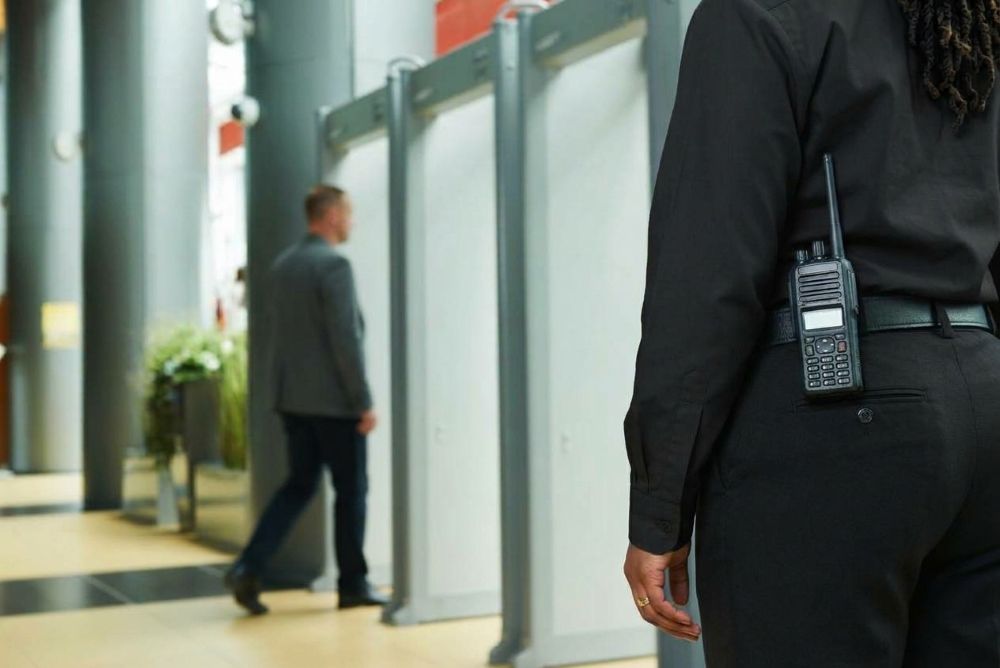
Surveillance and Monitoring: Filling the Gaps
Cameras and video analytics extend your security coverage into areas and hours where physical personnel are not cost-effective to station. A well-designed surveillance system works alongside guards and access control to create a comprehensive picture of building activity.
Modern IP-based camera systems offer high-resolution footage, remote viewing, motion-triggered alerts, and integration with access control platforms so that an access event can automatically pull up the corresponding camera feed for verification.
For large office properties, video analytics software can identify unusual behavior patterns, flag abandoned objects, and generate alerts without requiring a human operator to watch every feed in real time. This matters because research from RAND Corporation consistently shows that human monitoring attention degrades significantly after extended periods, making automated alerts a practical necessity.
Key placement priorities include:
- All building entrances and exits
- Elevator banks and stairwells
- Parking structures and loading docks
- Server rooms and executive areas
- Common areas including break rooms and reception zones
Retention policies also require attention. Many U.S. states have specific requirements around how long video footage must be kept, and legal counsel in some industries may require longer retention for liability purposes.
Visitor Management: Knowing Who Is in Your Building
Visitor management is one of the most frequently overlooked elements of commercial security. Many buildings with strong access control for employees operate a loosely controlled open-door policy for visitors, creating a significant vulnerability.
A structured visitor management system should include:
- Pre-registration: Hosts invite guests through a digital system before arrival, reducing lobby bottlenecks and creating a record before the visit.
- Government-issued ID verification: Guards or kiosks confirm identity against a photo ID at check-in.
- Visitor badges: Time-stamped, expiring badges that are visually distinct from employee credentials allow staff to spot unauthorized individuals on any floor.
- Escort requirements: Sensitive areas should require that visitors be accompanied by an authorized employee at all times.
- Sign-out and badge return: A complete log closes the loop and ensures no unauthorized individuals remain after business hours.
Digital visitor management platforms like Envoy or Proxyclick integrate with access control systems and Slack or email notifications, giving hosts real-time arrival alerts. This is no longer a luxury for large enterprises; even mid-size companies benefit significantly from the structure these platforms provide.
The Department of Homeland Security publishes guidance on visitor screening best practices for facilities with sensitive operations, and many of those principles apply to standard commercial office environments as well.
Emergency Preparedness and Incident Response
Even the best preventive measures cannot eliminate every risk. How your building responds when something goes wrong determines whether an incident becomes a manageable event or a catastrophe.
Your emergency preparedness plan should address:
- Active threat protocols: Coordinated with local law enforcement, including lockdown procedures and evacuation routes.
- Medical emergencies: Guards trained in CPR and AED use, with clear protocols for contacting 911 and directing first responders to the correct location.
- Fire and evacuation: Designated assembly points, floor warden assignments, and regular drills ensure orderly evacuation.
- Power and system failures: Backup power for access control systems and cameras is essential; a power outage should not mean every door is suddenly unlocked.
- After-hours incidents: Clear escalation procedures so security personnel know exactly who to contact at any hour.
Tabletop exercises and annual drills keep procedures current and reveal gaps before a real event exposes them. The FEMA Ready Business program provides free frameworks that many U.S. facility managers use as a starting baseline.
Building a Security Culture Among Employees
Technology and guards provide the structure, but your employees are your largest and most distributed security asset. A workforce that understands basic security expectations significantly extends the reach of any formal program.
Practical steps for building security awareness include:
- Onboarding security training that covers badge use, tailgating prevention, visitor escort responsibilities, and incident reporting.
- Clear and posted protocols for reporting suspicious behavior, so employees know exactly who to contact and how.
- Regular email or intranet updates on emerging threats or recent incidents, framed as awareness rather than alarm.
- A no-shame policy for asking questions about whether someone belongs in a space, sometimes called the “challenge culture” in corporate security programs.
The Society for Human Resource Management (SHRM) documents that organizations with integrated security awareness programs see meaningfully lower rates of insider incidents compared to those treating security as a purely technical or guard-based function. When employees understand the “why” behind security policies, compliance increases and vigilance becomes part of the workplace culture rather than an imposition.
Managers play an outsized role here. When leadership models badge discipline, enforces visitor protocols, and takes security reporting seriously, it signals to the entire organization that these are real expectations, not optional suggestions.
YOU MAY ALSO LIKE: Workplace Violence Prevention: How Security Guards Protect Employees Every Day

Frequently Asked Questions
How much does it cost to hire a professional lobby security guard for an office building?
The cost of a professional lobby guard varies based on location, shift length, required training level, and whether you use armed or unarmed personnel.
In most major U.S. markets, unarmed commercial security guards typically range from $20 to $45 per hour depending on the city, building type, and service provider. Armed guards and those with specialized certifications command higher rates. Most providers like Instaguard Security Services offer customized contracts that account for your specific coverage hours, number of posts, and reporting requirements, so the best approach is to request a site assessment before comparing quotes.
What is the difference between access control and a visitor management system?
Access control governs who can enter specific areas of a building using credentials like key cards, fobs, or biometrics, while a visitor management system tracks and logs temporary guests who do not hold permanent credentials.
The two systems are complementary rather than interchangeable. Access control handles your permanent population of employees and contractors through automated permissions and audit trails. A visitor management system handles the dynamic, daily flow of clients, vendors, and guests by capturing identity verification, issuing temporary badges, and logging arrival and departure times. Buildings with strong security programs run both in parallel, often with integration so that a visitor’s temporary credential is automatically deactivated when they sign out.
Can a small or mid-size office building justify the cost of professional security guards?
Yes. The cost of a security incident, including theft, liability claims, or a workplace violence event, almost always exceeds the cost of preventive guard services over the same period.
Small and mid-size buildings often assume guards are only for corporate campuses or high-rises, but that assumption leaves them exposed to risks that are statistically just as likely to occur in smaller properties. Part-time or shared guard arrangements, where a single officer covers multiple tenants or a shorter daily window, can make professional security services accessible at a lower total cost. Instaguard Security Services works with properties of varying sizes to design coverage plans that fit both the threat profile and the budget, rather than applying a one-size-fits-all model.
How do you prevent tailgating at a secured office building entrance?
Tailgating prevention requires a combination of physical barriers, trained personnel, and employee awareness, because no single measure eliminates it on its own.
Physical solutions include turnstiles, mantrap vestibules, and door sensors that alert when two people pass through on a single credential event. Lobby guards positioned to observe entry points are highly effective because they can intervene in real time, something a camera or alarm cannot do. Employee training is equally important: staff should understand that allowing a stranger to follow them through a controlled door, even as a polite gesture, is a genuine security risk. Organizations that combine all three layers consistently report lower tailgating rates than those relying on technology alone.
What credentials or certifications should I look for when hiring a security guard company for my office building?
At a minimum, the provider must hold a valid state security contractor license and employ guards who meet your state’s individual guard registration or licensing requirements.
Beyond baseline licensing, look for providers whose guards receive documented training in CPR and first aid, conflict de-escalation, emergency response procedures, and the specific protocols relevant to your building type. Ask whether the company conducts background checks on all personnel, how they supervise guards during overnight and weekend shifts, and whether they carry adequate general liability and workers’ compensation insurance. Reputable providers like Instaguard Security Services should be able to produce proof of licensing, insurance certificates, and a clear description of their training curriculum before you sign any contract.
Office Building Security: Access Control, Lobby Guards, and Best Practices
Protecting your building is not a single decision made once and forgotten. It is an ongoing commitment to layering the right systems, the right people, and the right policies in a way that adapts as your organization and the threat environment evolve. Access control systems provide the automated structure, lobby guards bring the human judgment and deterrence that technology cannot replicate, and clear protocols ensure everyone in the building knows how to respond when something goes wrong.
The most effective programs do not treat any one element as sufficient on its own. If you are evaluating your current setup, start with a professional security assessment to identify the gaps between where your building is today and where it needs to be. Instaguard Security Services specializes in helping facility managers and property owners build security programs that are practical, scalable, and right-sized for the realities of commercial office environments. Reach out for a consultation and take the first concrete step toward a building that is genuinely protected, not just visibly guarded.
READ MORE: Retail Security and Loss Prevention: How Guards Reduce Shrinkage Across Every Store Format
This content is for informational purposes only and is not legal, insurance, or compliance advice. California security licensing requirements and regulations may change. For a tailored security assessment or to confirm current service options, contact Instaguard Security at (800) 786-0698 or visit instaguardinc.com.