

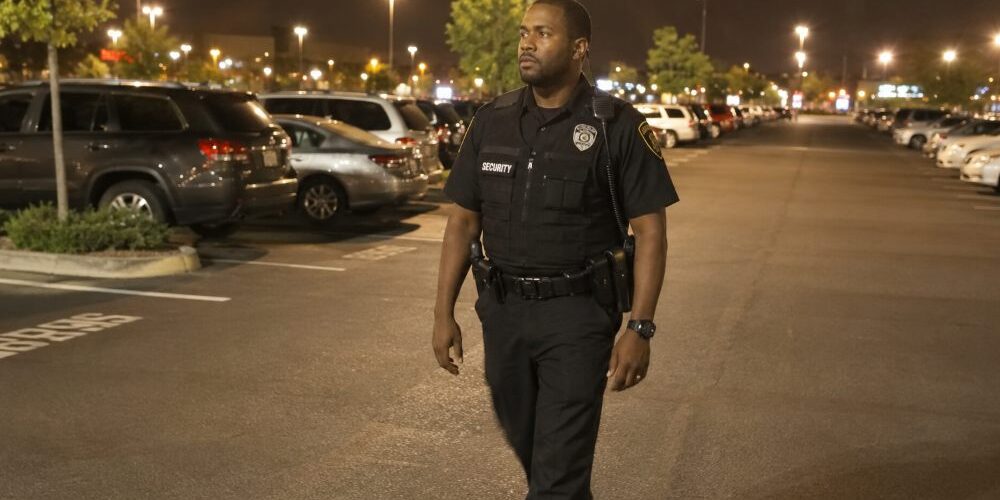
Parking lots are among the most vulnerable areas on any commercial or residential property, and professional parking lot security guard services significantly reduce the risk of vehicle theft, vandalism, loitering, and unauthorized access. Deploying trained security personnel around the clock means your property stays protected whether it is 2 p.m. on a Tuesday or 3 a.m. on a Sunday.
Table of Contents
Why Parking Lots Are High-Risk Areas for Crime
What 24/7 Patrol and Monitoring Actually Involves
Comparing Security Options for Parking Areas
What to Expect From a Professional Security Provider
The Real Cost of Skipping Professional Parking Security
Ready to Protect Your Parking Area With Trained Security Personnel?
The Bottom Line on Professional Parking Lot Security Guard Services
Key Takeaways
- Parking lots rank among the most common locations for property crime in the United States, making consistent security coverage essential.
- A combination of foot patrols, vehicle patrols, and surveillance monitoring delivers the strongest deterrence.
- Visible security presence reduces opportunistic crime significantly compared to cameras or signage alone.
- Incident reporting by trained guards creates a documentation trail that supports insurance claims and legal action.
- Customized patrol schedules, including randomized routes, prevent predictability that criminals can exploit.
- Security coverage should be matched to your property type, whether it is a shopping center, apartment complex, hotel, or office campus.
Why Parking Lots Are High-Risk Areas for Crime
Most property owners focus security resources on building interiors and entry points, leaving parking areas as an afterthought. That is a costly mistake. According to the FBI’s Uniform Crime Reporting Program, parking lots and garages consistently rank as one of the top locations where property crimes, robberies, and assaults occur across the United States.
The risk factors are straightforward. Parking lots are often poorly lit, have limited natural surveillance from passersby, and see a high turnover of unfamiliar vehicles and individuals. This creates an environment where criminals feel confident acting without being caught. Vehicle break-ins, catalytic converter theft, vandalism, and carjacking are all crimes that spike in unmonitored parking areas.
For businesses, this is not just a safety issue. It is a liability issue. If a customer or tenant is victimized on your property and you failed to take reasonable precautions, you may face legal exposure. The National Crime Prevention Council notes that property managers have a duty of care that extends to the parking areas they control.
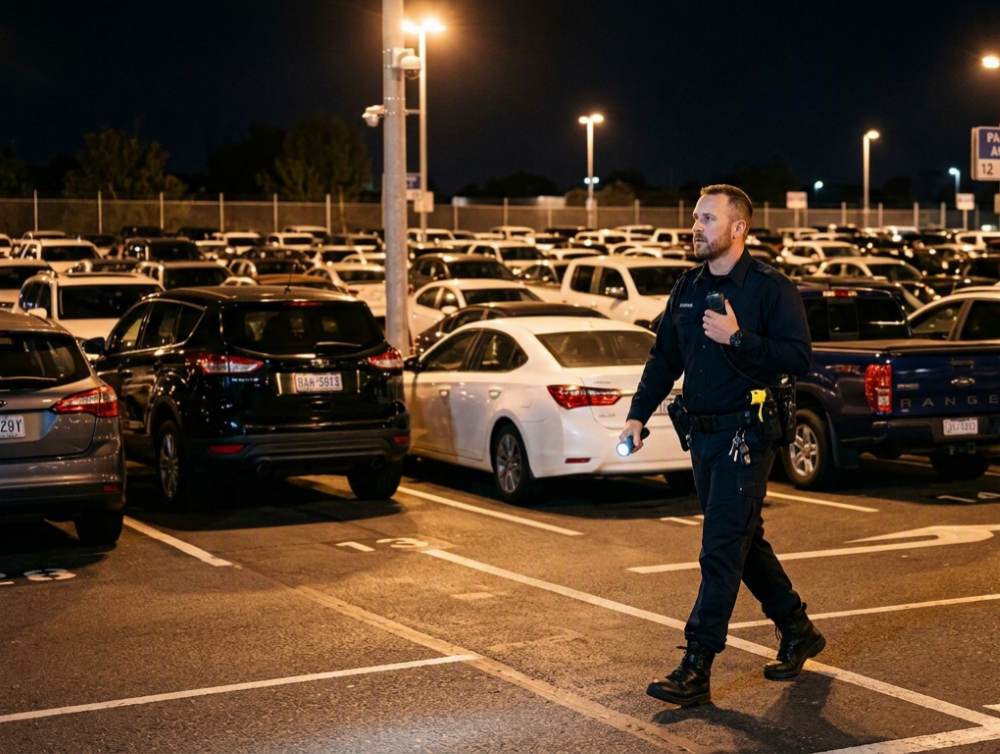
What 24/7 Patrol and Monitoring Actually Involves
The phrase “24/7 security” gets used loosely, but in practice it covers several distinct layers of protection that work together. Understanding what each layer does helps you evaluate whether a security provider is offering genuine coverage or just a basic presence.
Foot Patrols
On-foot security officers walk designated routes through your parking area on a scheduled and randomized basis. This unpredictability is important. When criminals observe a predictable patrol pattern, they adjust around it. Randomized timing closes that window. Foot patrols are particularly effective for catching individuals attempting break-ins, confronting loiterers, and assisting customers who feel unsafe walking to their vehicles.
Vehicle Patrols
For larger parking areas, vehicle patrols allow a single officer to cover significantly more ground in less time. A patrol vehicle also serves as a highly visible deterrent. Seeing a marked security vehicle make regular passes through a lot discourages opportunistic crime in a way that static cameras simply cannot replicate. Vehicle patrols are a strong fit for apartment communities, shopping centers, industrial parks, and large office campuses.
Surveillance Monitoring
Modern security operations integrate CCTV and live monitoring with on-the-ground personnel. Officers stationed at a monitoring post can watch multiple camera feeds simultaneously and dispatch a patrol officer the moment something looks suspicious. This combination of eyes on the ground and eyes on the screen creates layers of coverage that are difficult to evade.
Incident Reporting and Documentation
Every incident, from a minor fender-bender to a vehicle break-in, should be formally documented. Trained security officers produce detailed incident reports that note the time, location, individuals involved, and actions taken. This documentation supports insurance claims, informs local law enforcement, and helps property managers identify patterns that may require additional security measures.
Comparing Security Options for Parking Areas
Not every parking lot has the same needs. The right combination of security resources depends on the size of your property, the volume of foot traffic, the crime trends in your area, and your budget. The table below breaks down common security options and their trade-offs.
| Security Option | Best For | Strengths | Limitations |
| Foot Patrol Officers | Smaller lots, high-traffic pedestrian areas | Direct interaction, visible deterrent, immediate response | Limited coverage area per officer |
| Vehicle Patrol Officers | Large properties, multi-building campuses | Fast response, wide coverage, strong visual deterrent | Less effective for pedestrian-level incidents |
| CCTV with Remote Monitoring | Any property size | Continuous coverage, low ongoing cost | Reactive, not proactive; no physical presence |
| Static Guard Post | Entry/exit-controlled lots | Access control, strong deterrence at key points | Limited to post area, not mobile |
| Combined Patrol and Monitoring | Shopping centers, hotels, hospitals | Layered protection, proactive and reactive | Higher cost, requires coordination |
For most commercial properties, a combined approach delivers the strongest results. Relying on cameras alone is a reactive strategy: you find out what happened after the fact, but you do not prevent it.
What to Expect From a Professional Security Provider
When you hire a professional security company, you should receive more than just a warm body in a uniform. A reputable provider brings licensed, trained personnel who understand how to de-escalate situations, communicate professionally with customers and tenants, and follow established protocols during emergencies.
In California, security guards must be licensed through the California Bureau of Security and Investigative Services (BSIS), which is part of the Department of Consumer Affairs. This licensing requirement ensures that guards meet minimum training standards and pass background checks. Any security company operating in Los Angeles or San Francisco must comply with these regulations, and you should verify compliance before signing a contract.
A professional provider should also offer:
- Customer assistance, because security officers often serve as the first point of contact for visitors who need help
- Customized patrol schedules designed around your property’s specific risk profile
- Clear communication protocols between guards and property management
- Flexible scheduling options for short-term events or long-term contracts
- Parking enforcement capabilities, including documentation of unauthorized vehicles
READ MORE: Types of Security Patrols: Which One Is Right for Your Property?
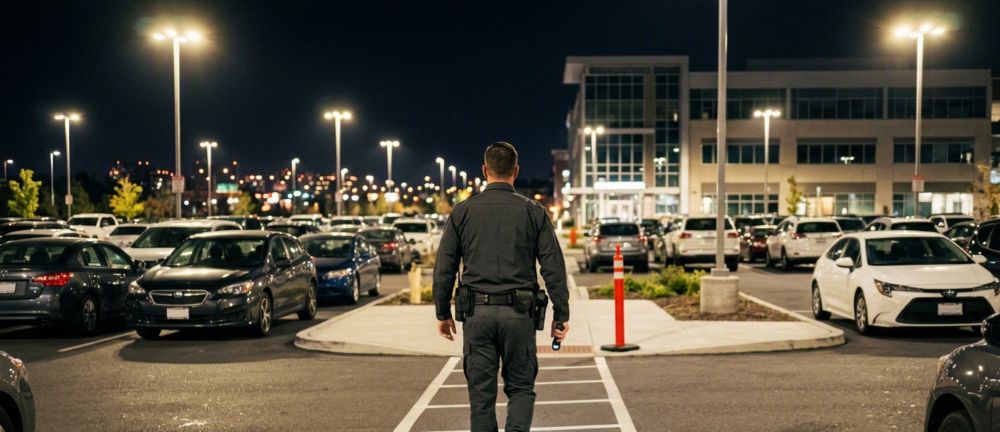
The Real Cost of Skipping Professional Parking Security
Some property managers calculate the cost of a security guard and decide it is an unnecessary expense. That calculation rarely accounts for the full picture. According to the Insurance Information Institute, vehicle theft costs Americans billions of dollars each year, and the liability exposure from crimes that occur on poorly secured properties can far exceed the cost of preventive security measures.
Here is what the math often looks like in practice:
- A single vehicle break-in on your property can lead to a tenant or customer complaint, a negative review, and in some cases a demand letter from an attorney.
- Catalytic converter theft alone can cost a vehicle owner between $1,000 and $3,000 per incident in repair costs.
- A pattern of incidents in your lot can raise your property insurance premiums or result in policy conditions requiring you to implement security measures anyway.
- Businesses in high-crime areas that invest in visible security consistently report higher tenant retention and customer satisfaction scores.
The National Institute of Justice has published research showing that environmental crime prevention strategies, including visible security presence, are among the most cost-effective tools available to property managers.
Things to Know
- Security guard licensing requirements vary by state. In California, all security personnel must hold a valid BSIS guard card, and the company itself must carry a valid contractor’s license.
- Randomized patrol schedules are more effective than fixed routes because they eliminate predictable gaps criminals can exploit.
- Parking enforcement is a distinct service within parking security. Make sure your provider explicitly offers documentation of unauthorized vehicles and towing coordination if needed.
- Security cameras without live monitoring or a responding officer are a documentation tool, not a prevention tool.
- Not all security companies carry adequate liability insurance. Request proof of coverage before entering any agreement.
- After-hours and overnight shifts tend to carry higher risk. Confirm that your provider staffs those hours with experienced personnel, not just entry-level guards.
Ready to Protect Your Parking Area With Trained Security Personnel?
The single most effective step you can take right now is to schedule a property assessment with a licensed security provider. A qualified security consultant will walk your parking area, identify blind spots, assess lighting, evaluate current access controls, and recommend a coverage plan tailored to your property type and risk level. Do not wait for an incident to occur before taking action. Reach out to InstaGuard Security Services today to discuss patrol scheduling, guard placement, and monitoring options for your Los Angeles or San Francisco property.
Frequently Asked Questions
Q: How many security guards do I need for a parking lot?
The number depends on your lot’s size, layout, traffic volume, and hours of operation.
A small surface lot may be adequately covered by a single officer during peak hours, while a multi-level parking structure serving a hospital or shopping center may require multiple guards across overlapping shifts. A professional security assessment will give you a more accurate figure based on your specific property.
Q: What is the difference between a static security guard and a patrol guard for parking lots?
A static guard is positioned at a fixed post, such as an entry booth, while a patrol guard moves throughout the property on scheduled or randomized routes.
For parking lots, a combination of both is often most effective. A static guard controls access at entry and exit points while a patrol officer monitors the interior of the lot for suspicious activity, assists customers, and deters loitering.
Q: Can a parking lot security guard issue citations or tow vehicles?
Security guards can document violations and initiate towing through contracted towing companies, but they do not have the authority to issue government traffic citations.
Parking enforcement by security personnel typically involves documenting unauthorized vehicles, placing warnings, and coordinating removal through a licensed tow operator. Any property signage regarding towing must comply with California Vehicle Code requirements.
Q: Do I need 24/7 security or just overnight coverage?
It depends on when your property sees the highest risk activity, which varies by property type and location.
Retail parking areas may need heavier coverage during peak shopping hours and weekend evenings. Apartment or residential lots often require stronger overnight coverage when residents are sleeping and the lot is largely unmonitored. Your security provider should review incident history and local crime data to recommend the right schedule.
Q: What should I look for in a parking lot security company?
Look for a licensed provider with verifiable credentials, trained personnel, liability insurance, and a clear plan for incident reporting and communication.
In California, verify that the company and its guards are licensed through the BSIS. Ask about staff turnover, training protocols, supervision practices, and how they handle emergencies. A company that cannot answer these questions clearly is a company worth avoiding.
The Bottom Line on Professional Parking Lot Security Guard Services
Parking lots are not passive spaces. They are active environments where theft, vandalism, and safety incidents occur every day across commercial and residential properties in the United States. Investing in professional parking lot security guard services gives you the combination of visible deterrence, active patrol, and documented incident management that cameras and signage alone cannot provide.
Whether your property is a shopping center in Los Angeles, an apartment community in San Francisco, or a healthcare campus anywhere in between, the right security coverage starts with a conversation. Contact Instaguard Security Services to schedule a site assessment and build a patrol and monitoring plan that fits your property’s needs and your budget.
READ MORE: Hotel Security Guard Services: A Complete Guide to Keeping Guests Safe