

Table of Contents
What Goes Into an Event Security Plan (And Why It Is Not Just “Hiring Guards”)
Step 1: Run a Site-Specific Risk Assessment First
Step 2: Lock In Roles, Coverage Zones, and Written Post Orders
Step 3: Coordinate With Local Authorities and the Venue
Step 4: Match Personnel and Technology to the Event Profile
Step 5: Set Up Communications, Reporting, and a Real Post-Event Review
Lock In Your Event Security Plan Before the Calendar Fills Up
Key Takeaways
- An event security plan is a written, site-specific document, not just a headcount.
- Risk assessment comes first. Every other decision depends on it.
- Post orders make guards accountable. No post orders, no defense.
- Private security supplements LAPD, LAFD, and EMS. It does not replace them.
- Reporting protects you in the 90 days after the event ends. Insist on it.
A 200-guest wedding in Calabasas and a corporate product launch in Downtown LA have almost nothing in common. Different venues, different guests, different timelines, different things that can go wrong. Ask any seasoned event organizer in California what they wish they had known sooner, and the answer rhymes: build the event security plan early, build it specific to the site, and put it on paper.
Most planning conversations skip that part. Catering gets locked in by week two. The DJ is confirmed by week three. Security shows up in the last fourteen days, treated like a checkbox instead of a system.
That sequence is backwards. Below are the five steps that actually work, in the order they actually need to happen.
What Goes Into an Event Security Plan (And Why It Is Not Just “Hiring Guards”)
An event security plan is a written, site-specific document that maps risk, defines who covers what, sets the communication chain, and outlines what happens when something goes sideways. It is separate from venue security (the people watching the building) and separate from your catering team’s allergy list. Your security plan is yours and it follows your event.
For California organizers, two things make this non-negotiable. Anyone working private security at your event must be licensed through the Bureau of Security and Investigative Services (BSIS). Hire unlicensed help and the liability lands on the organizer, not the vendor. Insurance carriers and venue contracts also increasingly ask for documented security planning before they sign off on coverage or final permits.
A real plan answers one question: if something happens, who is doing what, and how fast?
Step 1: Run a Site-Specific Risk Assessment First
Every downstream decision (guard count, coverage type, perimeter design, evacuation routing) flows from this step. Skip it and you are guessing.
A real assessment looks at venue layout, ingress and egress, expected attendance, alcohol service, VIP presence, cash handling, valuable assets, time of day, neighborhood context, weather, and any adjacent events on the same block.
A site-specific risk assessment should should produce:
- A ranked threat profile by likelihood and impact
- Recommended guard count, post locations, and patrol pattern
- A communications plan and chain of command
- An emergency action plan tied to the venue’s existing protocols
Step 2: Lock In Roles, Coverage Zones, and Written Post Orders
This is where most weak plans collapse. Organizers know they want “security.” They never define what each guard is actually doing.
Coverage zones should be mapped to your venue floor plan: entry points, VIP areas, back-of-house, parking, stage perimeter, alcohol service points, emergency exits. Every zone gets a post. Every post gets a post order, which is the written, site-specific instructions a guard follows on duty. Post orders cover the assigned location, shift boundaries, reporting structure, authorized actions, when to escalate, and the emergency contact tree.
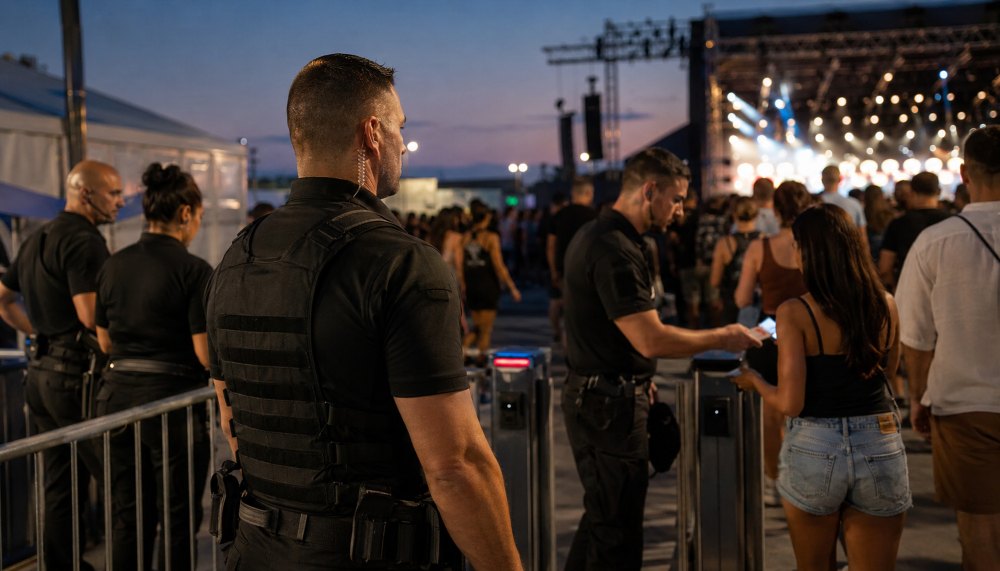
Standard roles at most events include a site supervisor (your single point of contact), access control officers at credential check, roaming patrol officers, static post officers at stage, VIP, and cash points, and executive protection or bodyguard coverage for specific guests where the risk profile calls for it. Without post orders, accountability disappears. So does your insurance defense if anything goes wrong.
Step 3: Coordinate With Local Authorities and the Venue
Private security is not a replacement for police, fire, or EMS. The plan should define exactly where private coverage ends and where public services take over.
For events in the City of Los Angeles, the Special Events Permit process may require coordination with LAPD, LAFD, or the Bureau of Street Services depending on attendance, street use, or amplified sound. Pasadena, Long Beach, Santa Monica, and Burbank each run their own permit processes. Confirm conditions early; permit reviewers do not move on your timeline.
Venue coordination is the other half. House security, AV, catering, valet, and every contracted vendor team needs to know who the site supervisor is, which radio channel or comms tool to use, how emergencies escalate, and where the nearest exits and medical resources sit. One unified incident reporting protocol beats five separate ones every time.
Step 4: Match Personnel and Technology to the Event Profile
Headcount is the wrong starting point. Profile is the right one. For instance, a 500-person black-tie gala in Pasadena and a 500-person concert in Long Beach call for different coverage models.
| Coverage Approach | Best Fit | Trade-off |
| Unarmed uniformed guards | Most private events, corporate functions, weddings, community gatherings | Visible deterrence, lower intimidation, lower cost |
| Executive protection / bodyguard | High-profile guests, sensitive private events | Discreet coverage, higher per-officer cost |
| Vehicle patrol | Multi-acre venues, off-site parking, large-footprint events | Scheduled checks, covers scale, not stationed at fixed posts |
| Static plus mobile hybrid | Multi-zone events | Most common model, balances visibility and response speed |
An event security plan should be built around unarmed guards, vehicle patrol, and executive protection where the situation calls for it. Tools like credential scanning, body-worn cameras, and real-time radios support the coverage. Trained personnel interpret what those tools surface. If a vendor is selling you metal detectors before a risk assessment is done, the math is being run in the wrong order.
Step 5: Set Up Communications, Reporting, and a Real Post-Event Review
The plan does not end when the last guest leaves. The 30 to 90 days after an event are when insurance questions and incident claims usually surface.
During the event, every officer needs to know how to escalate, who to escalate to, and what level of incident triggers what response. Pre-defined tiers (information only, supervisor response, emergency response) keep the channel clear when it matters.
After the event, reporting matters more than most organizers expect: real-time incident logs with timestamps, daily activity reports for multi-day events, a post-event written summary, and records retained for the insurance and liability window.
Real-time incident reporting should be part of the standard documentation process; the reports protect you, not just the security team you hired. For recurring events like annual galas, monthly community markets, or quarterly conferences, the post-event debrief is where you find out what to change before next time.
Lock In Your Event Security Plan Before the Calendar Fills Up
If your event is on the calendar, your security plan should already be in motion. Two weeks is not enough lead time for a real assessment, a real plan, or proper coordination with city permits and venue staff. Eight weeks is better. Twelve is better still for anything public-facing.
Instaguard Security has been staffing events across LA County and California since 2008. We offer free consultations, site-specific risk assessments, and event coverage built around unarmed guards, vehicle patrol, and executive protection where the situation requires it. No flashy slogans, no overselling.
Frequently Asked Questions
What is an event security plan?
An event security plan is a written, site-specific document covering your event’s risk profile, guard placement, coverage zones, post orders, communication protocols, and emergency response. It is separate from venue security and tailored to your event’s size, guests, and timeline.
How much does event security cost in Los Angeles?
Cost varies by event size, hours, risk level, and coverage type (unarmed, executive protection, vehicle patrol). Reputable companies provide a written quote after reviewing event details. Instaguard offers free consultations and quotes based on site specifics.
Do I need armed or unarmed guards for my event?
For most private and corporate events, unarmed uniformed guards are appropriate. Armed coverage is generally reserved for executive protection situations where the risk profile justifies it. California requires armed officers to hold a separate BSIS exposed firearm permit alongside their guard registration.
How far in advance should I book event security?
For private events under 200 people, two to four weeks is usually workable. Public-facing events, festivals, or events requiring city permits should be planned 8 to 12 weeks out. Earlier means more options on guard mix, coverage hours, and pricing.
Are private event security guards regulated in California?
Yes. All private security personnel working in California must be licensed by the Bureau of Security and Investigative Services (BSIS), including background checks, fingerprinting, and required training. Hiring unlicensed help shifts liability to the organizer. Regulations may change, so confirm current requirements directly with BSIS.
Compliance Disclaimer
This content is for informational purposes only and is not legal, insurance, or compliance advice. California security licensing requirements and regulations may change. For a tailored security assessment or to confirm current service options, contact Instaguard Security.