
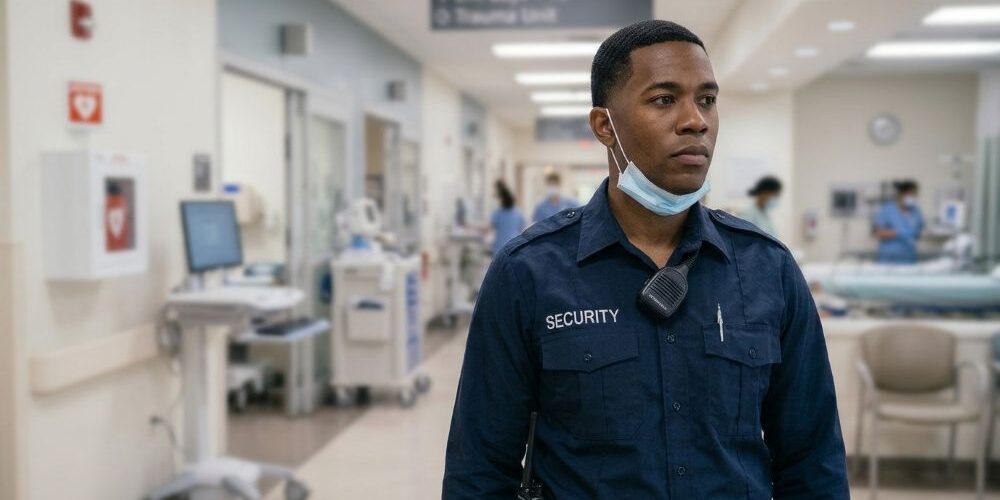
Hospital security guards are trained professionals responsible for protecting patients, staff, and visitors while maintaining a safe clinical environment. Their role spans access control, emergency response, behavioral intervention, and direct coordination with nursing and administrative teams.
That scope is broader than most people assume. Security in a healthcare setting is not the same as security at a retail store or corporate office. The patient population includes people in acute distress, under the influence of substances, or experiencing psychiatric crises, and the team on shift needs to be prepared for all three before 7 a.m.
Who this is for: This article is written for hospital administrators, HR directors, and security managers evaluating whether their current guard program actually covers the clinical risks their facility faces daily. Not for: General readers looking for a career overview or entry-level job descriptions. This is an operational and procurement-focused breakdown.
Key Takeaways
- Hospital security guards manage far more than access points. Their duties include patient monitoring, contraband screening, behavioral intervention, and emergency coordination.
- De-escalation training is not optional in a modern ER. Verbal intervention skills directly reduce the number of physical confrontations requiring law enforcement.
- Access control failures are the most commonly cited gap in Joint Commission hospital security reviews.
- Guards working alongside clinical staff, rather than in parallel to them, produce measurably better safety outcomes.
- Not every security firm has healthcare-specific training. Vetting for hospital experience matters more than general licensing alone.
- Instaguard Security Services deploys guards specifically trained in hospital protocols, including HIPAA-aware procedures and ER behavioral response.
What Hospital Security Guards Actually Do on a Shift
The public image of a hospital security guard is someone sitting at a front desk checking badges. In practice, a typical shift at a mid-size acute care facility involves a lot more than that.
Access control is the foundation. Guards manage entry points, verify credentials for restricted areas like the ICU and pharmacy, and track visitor badges in real time. The Joint Commission identifies uncontrolled access as one of the top vulnerabilities in hospital security assessments, particularly in facilities that run 24-hour emergency departments.
Beyond the doors, guards conduct regular patrols of parking structures, stairwells, and behavioral health units. They respond to elopement alerts when patients leave without medical clearance, assist with combative patients who cannot safely be managed by clinical staff alone, and document incidents for risk management review.
What usually trips facilities up here is the assumption that general security experience transfers cleanly into a hospital context. It does not. Healthcare environments carry regulatory obligations around patient privacy, use-of-force limitations near clinical equipment, and escalation protocols that must align with nursing staff directives rather than override them.
ER Protection: The Highest-Risk Zone in Any Facility
Emergency rooms are statistically the most dangerous area in a hospital for staff assaults. According to the U.S. Bureau of Labor Statistics, healthcare workers face assault rates nearly five times higher than workers in other industries, with emergency department staff carrying a disproportionate share of that risk.
The ER environment creates conditions that escalate fast. Patients arrive in pain or in withdrawal. Wait times are long. Family members are frightened and frustrated. Guards assigned to ER protection need skills that go beyond physical presence.
| Security Capability | General Security Guard | Hospital-Trained Guard |
| Access control and badging | Yes | Yes, with clinical zone awareness |
| De-escalation verbal intervention | Basic or none | Structured protocols (CPI or equivalent) |
| Psychiatric patient interaction | No specific training | Trauma-informed approach required |
| HIPAA-aware incident documentation | No | Yes |
| Coordination with nursing staff | Ad hoc | Defined escalation protocols |
| Elopement response | No | Yes, with clinical notification steps |
The comparison above is not academic. Facilities that deploy guards without healthcare-specific training often find those guards either under-responding to real threats or over-responding in ways that create liability. Both failures cost money and damage patient trust.
Instaguard Security Services assigns hospital security personnel who have completed healthcare-specific orientation, including scenario-based ER training and coordination drills with clinical staff. That preparation changes how effectively a guard can read a waiting room and intervene before a situation requires force.
De-Escalation: The Skill That Prevents the Incident
De-escalation is not a soft skill. It is a technical discipline with measurable outcomes, and in a hospital environment it is one of the most cost-effective investments a security program can make.
The Crisis Prevention Institute (CPI), which trains healthcare and security professionals across the United States, defines de-escalation as a structured verbal and non-verbal process for reducing a person’s level of agitation before physical intervention becomes necessary. Guards trained in CPI or equivalent frameworks follow a defined sequence: recognize early behavioral cues, establish verbal contact using non-threatening language, offer choices to restore a sense of control, and involve clinical staff at the right moment.
What the pattern shows in practice is that most physical confrontations in hospital settings are preceded by a 10 to 20 minute window where verbal intervention was possible but missed, usually because the guard on duty was not positioned or trained to recognize the warning signs.
The trade-off is real. De-escalation training takes time and costs money upfront. Guards need refresher sessions regularly, not just at hire. Facilities that view training as a one-time orientation cost tend to see regression in guard performance within six months.
How Patient Safety Fits Into the Security Function
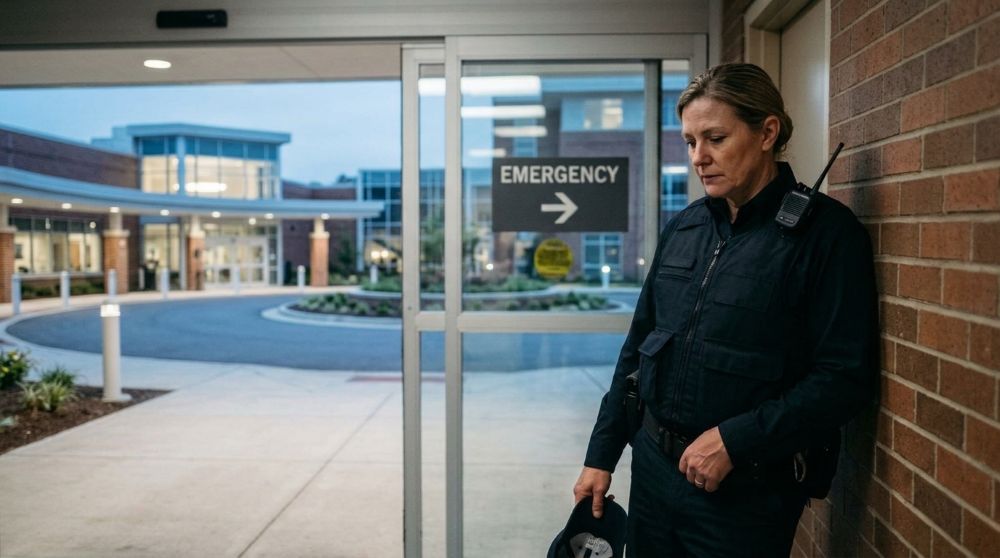
Patient safety is partly a clinical function, but security plays a direct supporting role that many hospitals underestimate. The Agency for Healthcare Research and Quality (AHRQ) recognizes workplace violence prevention as a patient safety issue, not just a staff safety issue, because violent incidents disrupt care delivery and create downstream harm.
Guards contribute to patient safety through several specific functions:
- Infant and pediatric security: Monitoring maternity units, responding to infant abduction alerts (code pink), and verifying identity for infant transport.
- Patient monitoring in behavioral health units: Conducting safety checks at defined intervals, logging observations, and communicating changes in patient status to nursing staff.
- Contraband screening: Identifying prohibited items in psychiatric and substance use treatment areas before they create harm.
- Parking and perimeter safety: Ensuring patients arriving by personal vehicle or rideshare are not intercepted or endangered in the facility’s exterior zones.
| Patient Safety Area | Guard Responsibility | Key Risk if Neglected |
| Maternity unit access | Verify entry credentials, respond to code pink | Infant abduction or unauthorized access |
| Behavioral health unit | Timed safety checks, contraband screening | Self-harm or contraband-related incidents |
| ER waiting area | Behavioral monitoring, early intervention | Escalation to assault or elopement |
| Parking and perimeter | Patrol, lighting checks, incident response | Assault or theft targeting patients and visitors |
Vetting a Hospital Security Partner: What to Actually Ask
If you are evaluating security vendors for a hospital contract, the licensing baseline is not enough. Every provider will show you a state guard card and insurance certificate.
The questions that separate qualified hospital security firms from general security companies are more specific:
- Do your guards receive healthcare-specific orientation before hospital deployment, or general orientation only?
- What de-escalation framework do your guards train in, and how frequently are they recertified?
- How do your guards document incidents in a way that protects facility HIPAA compliance?
- Can you provide references from other acute care or behavioral health facilities in our region?
Instaguard Security Services operates in the healthcare security space with guards trained on hospital-specific protocols, including behavioral health response and coordination with clinical staff. The American Society for Healthcare Engineering (ASHE) and the International Association for Healthcare Security and Safety (IAHSS) both publish standards that credible hospital security providers should be familiar with and able to demonstrate alignment with.
The catch is that not all vendors self-identify as healthcare specialists. Some will take a hospital contract and deploy standard commercial guards. That is a risk-management problem waiting to surface.
YOU MAY ALSO LIKE: HOA Security Guide: Do Gated Communities Need Security Patrols?
Frequently Asked Questions
What qualifications should hospital security guards have beyond a standard guard license?
Hospital security guards should hold a valid state security license and have completed healthcare-specific training in de-escalation, HIPAA awareness, and behavioral health response.
Most states require a guard card as the baseline, but that credential alone does not cover the clinical environment. Look for CPI certification or equivalent, plus documented hospital orientation from their employer.
How is ER security different from general hospital security?
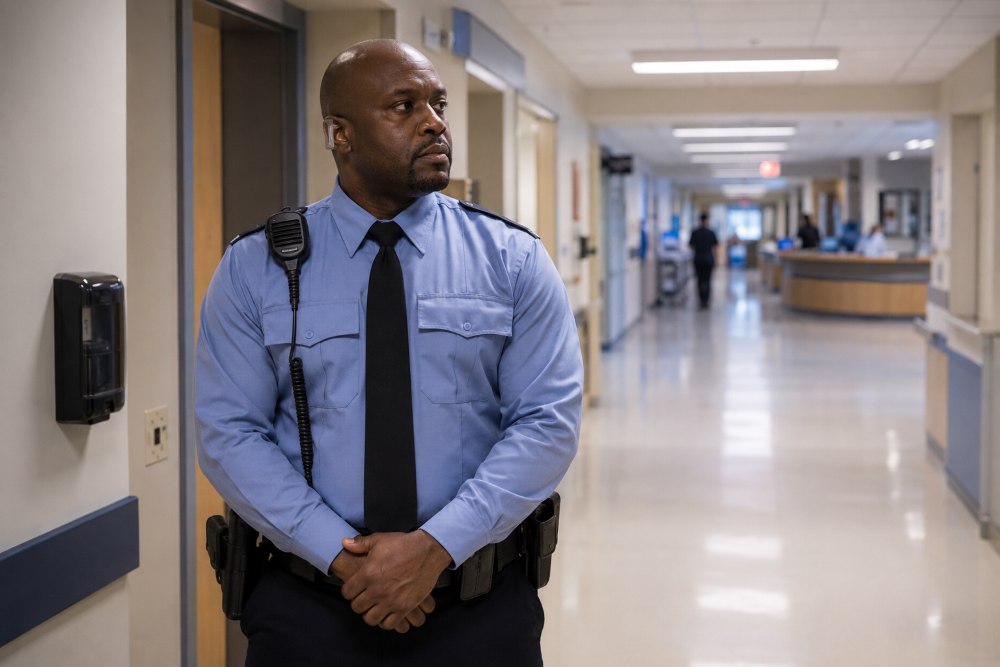
ER security requires faster behavioral assessment, higher tolerance for unpredictable patient behavior, and closer coordination with nursing staff than other hospital zones.
The ER population includes patients in acute medical, psychiatric, or substance-related distress. Guards in this area need training specific to those presentations, not generic crowd control skills.
Can hospital security guards physically restrain patients?
Hospital security guards can assist clinical staff with patient restraint in specific, defined circumstances, but the clinical team directs the process and documents it in the medical record.
This varies by state law and facility policy. Guards who restrain patients outside of those defined circumstances create liability for themselves and the facility. Proper training defines when and how physical intervention is appropriate.
What is the most common security gap Joint Commission surveyors find in hospitals?
Uncontrolled access to restricted areas, particularly during shift changes and high-traffic periods, is the most frequently cited finding.
This is an access control and staffing coverage problem, not purely a training problem. Facilities that rely on electronic access alone without guard presence at key transition points tend to show this gap.
How does Instaguard Security Services handle hospital-specific security needs?
Instaguard Security Services deploys guards with hospital-specific training, including ER behavioral response, clinical staff coordination protocols, and HIPAA-compliant incident documentation procedures.
Their guards are oriented to the particular demands of acute care environments before they go on shift, which reduces the adjustment period that creates early coverage risk.
The Bottom Line on Hospital Security Guard Duties: Patient Safety, ER Protection & De-Escalation
Hospital security guard duties extend well beyond access control and presence. The facilities that treat security as a clinical support function, rather than a physical deterrent alone, consistently see fewer serious incidents, lower liability exposure, and stronger staff retention because nurses and physicians feel protected.
If your current security contract was written without healthcare-specific requirements, that is the first thing to fix. Request a scope-of-duties review from your current provider, compare it against IAHSS standards, and use that gap analysis to drive a more precise vendor conversation. Instaguard Security Services is one option worth evaluating if your facility needs guards who arrive already trained for the clinical environment.
READ MORE: Vacant Property Security: Protecting Empty Buildings from Vandalism and Squatters
This content is for informational purposes only and is not legal, insurance, or compliance advice. California security licensing requirements and regulations may change. For a tailored security assessment or to confirm current service options, contact Instaguard Security at (800) 786-0698 or visit instaguardinc.com.