

Table of Contents
California’s Workplace Violence Prevention Law Most Owners Have Not Heard About
What Federal Guidance Says About Security’s Role
Not All Commercial Properties Have the Same Risk Profile
What to Verify Prior to Hiring
Building a Commercial Security Plan
Most business owners think about security only after something happens. A break-in, a theft, an incident with an angry customer or a difficult employee. By then, you are reacting instead of planning. Here is what commercial security actually covers, plus a legal requirement that applies to most California employers and that a lot of business owners have not heard about yet.
Key Takeaways
- California employers are now legally required to have a written Workplace Violence Prevention Plan under Senate Bill 553.
- Security guards are one of the measures both Cal/OSHA and federal OSHA recognize as part of a workplace violence prevention strategy.
- Commercial security needs differ significantly by business type. Office buildings, retail spaces, and warehouses each face different risks.
- Every guard providing commercial security in California must hold a valid BSIS Guard Card.
California’s Workplace Violence Prevention Law Most Owners Have Not Heard About
In 2023, California passed Senate Bill 553, which added a new requirement to state law. Most California employers now must establish, implement, and maintain a written Workplace Violence Prevention Plan, effective since July 1, 2024.¹
This is not a suggestion. It is a legal requirement enforced by Cal/OSHA, and it applies broadly across general industry, not just high-risk sectors like healthcare. The plan has to identify potential workplace violence hazards specific to your business and lay out how you will prevent and respond to them.
If you have not addressed this yet, you are behind on a compliance requirement, not just missing a nice-to-have. This alone is a good reason to take a real look at your commercial security setup rather than assuming your current setup is enough.
What Federal Guidance Says About Security’s Role
Federal OSHA has published guidance on workplace violence prevention for years, and it specifically calls out physical security measures as part of a prevention strategy. Recommendations include installing video surveillance, adding lighting, and minimizing outside access through identification badges, electronic keys, and guards.²
Notice that guards are named specifically, alongside cameras and access control, not instead of them. The strongest commercial security setups usually combine more than one of these elements rather than relying on just one.
Not All Commercial Properties Have the Same Risk Profile
“Commercial security” covers a wide range of business types, and what makes sense for one does not necessarily make sense for another.
- Office buildings generally deal with access control as the primary concern: who gets into the building, who gets past the lobby, and how visitors are managed. Risk tends to concentrate around entry points and after-hours access.
- Retail spaces face a different set of issues, including theft, customer-facing incidents, and cash handling risk, particularly during evening or late-night hours.
- Warehouses and distribution centers deal with large physical footprints, valuable inventory, loading dock activity, and a mix of employees, drivers, and vendors moving through the space, which makes perimeter control and monitoring a bigger priority.
- Mixed-use and multi-tenant properties often need security that can address several of these risk types simultaneously, since different tenants bring different foot traffic and different risks into the same building.
The point is that a generic security package rarely fits any of these well. What you actually need depends on your specific business, layout, and hours of operation.
READ MORE: How to Choose a Security Guard Company
Guards, Cameras, or Both
This comes up constantly, and the honest answer is that it depends on what you are trying to solve.
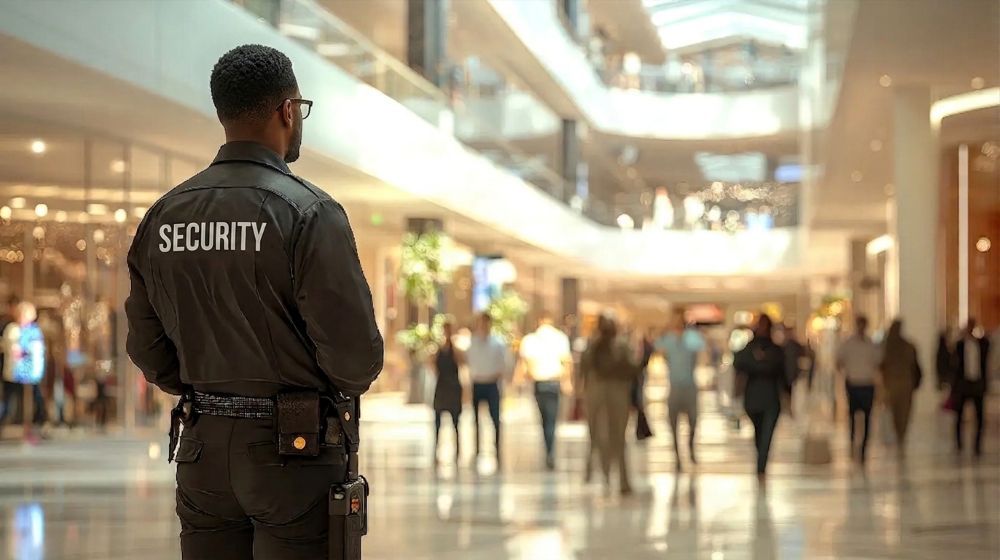
Cameras are good for documentation and deterrence, but they do not physically stop something from happening in real time and someone still has to monitor or review the footage. Guards provide a physical presence that can intervene, check credentials, and respond immediately, but they cost more than a camera system and are only one part of a layered approach.
Most businesses with real security needs end up using both. Cameras cover documentation and areas that do not need constant physical presence, while guards handle access control, physical deterrence, and response. Neither fully replaces the other.
What to Verify Prior to Hiring
Whatever you decide on, confirm that any guard working your property holds a valid BSIS Guard Card, and that the company providing them holds a Private Patrol Operator license to legally operate as a security provider in California.³ This is not optional and it is worth verifying directly rather than taking a company’s word for it.
Building a Commercial Security Plan
A reasonable starting point looks like this:
- Review and update the plan periodically, since business risks change over time
- Identify your specific risks based on your business type, hours, and location, ideally as part of your written Workplace Violence Prevention Plan if SB 553 applies to you
- Decide where physical presence matters most: entrances, loading docks, parking areas, or customer-facing zones
- Determine whether guards, cameras, access control systems, or a combination fits your risk level and budget
- Confirm any security provider you consider is properly licensed
Talk to a Security Specialist
If you are trying to figure out what commercial security actually makes sense for your property, or you still need to address California’s Workplace Violence Prevention Plan requirement, our team can walk through your specific situation with you.
Note: This is general information, not legal advice. Consult Cal/OSHA resources or a qualified professional to confirm how SB 553 applies to your specific business.
Sources
¹ California Department of Industrial Relations, Division of Occupational Safety and Health (Cal/OSHA). “Workplace Violence Prevention for General Industry (Non-health Care Settings).” dir.ca.gov. https://www.dir.ca.gov/dosh/Workplace-Violence/General-Industry.html
² Occupational Safety and Health Administration. “Workplace Violence.” osha.gov. https://www.osha.gov/sites/default/files/publications/factsheet-workplace-violence.pdf
³ California Department of Consumer Affairs, Bureau of Security and Investigative Services. “Security Guard Registration.” bsis.ca.gov. https://www.bsis.ca.gov/forms_pubs/guard_fact.shtml