

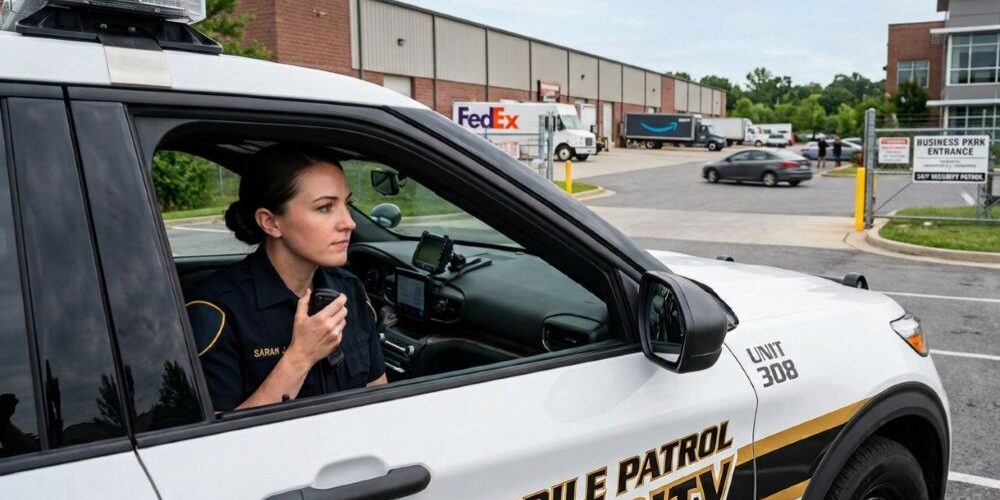
Static security guards are effective for fixed posts: a lobby, a gatehouse, a single entry point. But most business properties don’t have one fixed risk location. They have parking lots, loading docks, perimeter fencing, multiple buildings, and access points that span hundreds or thousands of square feet. Covering that range with stationed guards is expensive. Mobile patrol security services are built specifically to solve that problem.
This guide explains exactly what mobile patrol security is, what patrol officers do during a shift, who benefits most from vehicle patrol, and how to evaluate a provider.
Table of Contents
What Is Mobile Patrol Security?
What Does a Mobile Patrol Security Officer Do?
How Vehicle Patrol Security Works: The Patrol Cycle
Mobile Patrol vs. Static Security Guards: Which Is Right for Your Business?
Who Benefits Most from Mobile Patrol Security?
How to Hire a Mobile Patrol Security Company
Protect Every Corner of Your Property: Start Mobile Patrol Today
Quick Summary
- Mobile patrol security services use marked or unmarked vehicles to conduct randomized security checks across multiple locations or large properties, far more cost-effective than static guards for extensive coverage areas.
- The randomized nature of vehicle patrol is a key deterrence factor: unpredictable patrol timing prevents bad actors from identifying and exploiting coverage gaps.
- Mobile patrol officers perform property checks, alarm response, lock/unlock services, and incident documentation as standard service components.
- Businesses with multiple locations, large campuses, or properties that only need periodic checks benefit most from mobile patrol over fixed-post security.
- Mobile patrol is regulated at the state level. Licensed patrol officers must meet the same training and background check requirements as other security personnel.
What Is Mobile Patrol Security?
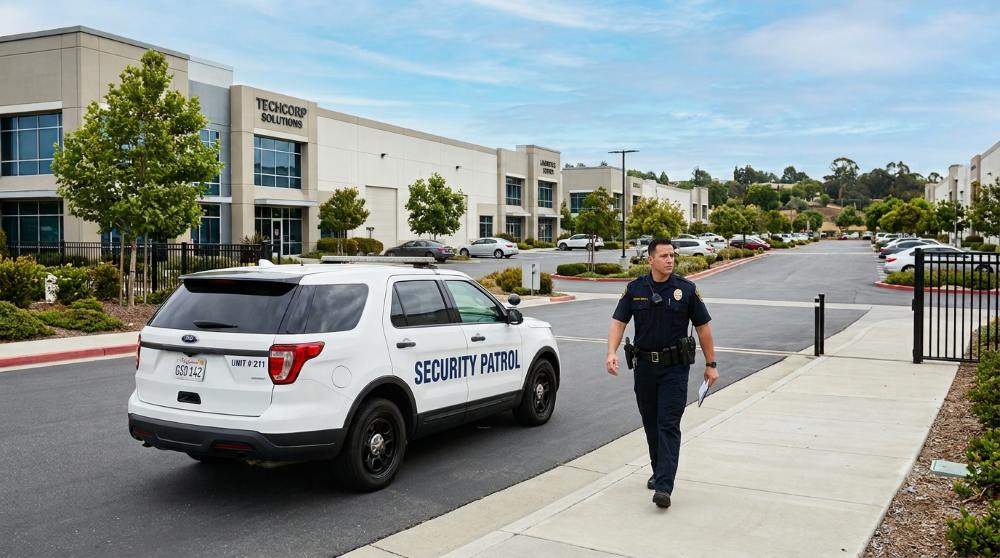
Mobile patrol security is a security delivery model in which uniformed officers conduct scheduled or randomized patrols of a property or group of properties using marked or unmarked vehicles. Rather than remaining at a single post, a mobile patrol security officer covers an assigned route, checking entry points, monitoring perimeter access, responding to alarms, and documenting observations in real time.
Crime-prevention research shows that people are less likely to commit opportunistic crimes when they believe they can be seen or caught. Apartment security guards support this by adding visible patrols, access monitoring, and real-time response in shared spaces.
What Does a Mobile Patrol Security Officer Do?
Scheduled and Random Property Checks
Mobile patrol officers follow an assigned route but vary their timing and sequence to prevent predictable patterns.
During each check, they inspect:
- Perimeter fencing and exterior walls
- Entry and exit points (gates, doors, loading bays)
- Parking lots and vehicle areas
- Exterior lighting (noting outages that create dark zones)
- Signage and visible deterrents
Alarm Response
Mobile patrol units serve as rapid-response assets when alarm systems trigger. Rather than waiting for police, a patrol officer can be on-site within minutes to assess and report the situation.
Lock/Unlock Services
For businesses that don’t have on-site staff after hours, mobile patrol officers can provide scheduled lock-up and opening services: checking that all access points are secured at close and ready for authorized access at open.
Incident Reporting
Every patrol check generates a documented record. Modern mobile patrol providers use digital reporting platforms that deliver real-time logs to clients, including GPS-verified checkpoint data showing exact patrol times and locations.
Parking Enforcement
For commercial properties with restricted parking, mobile patrol officers enforce designated parking zones, issue warnings or violation notices, and coordinate tow services when required.
How Vehicle Patrol Security Works: The Patrol Cycle
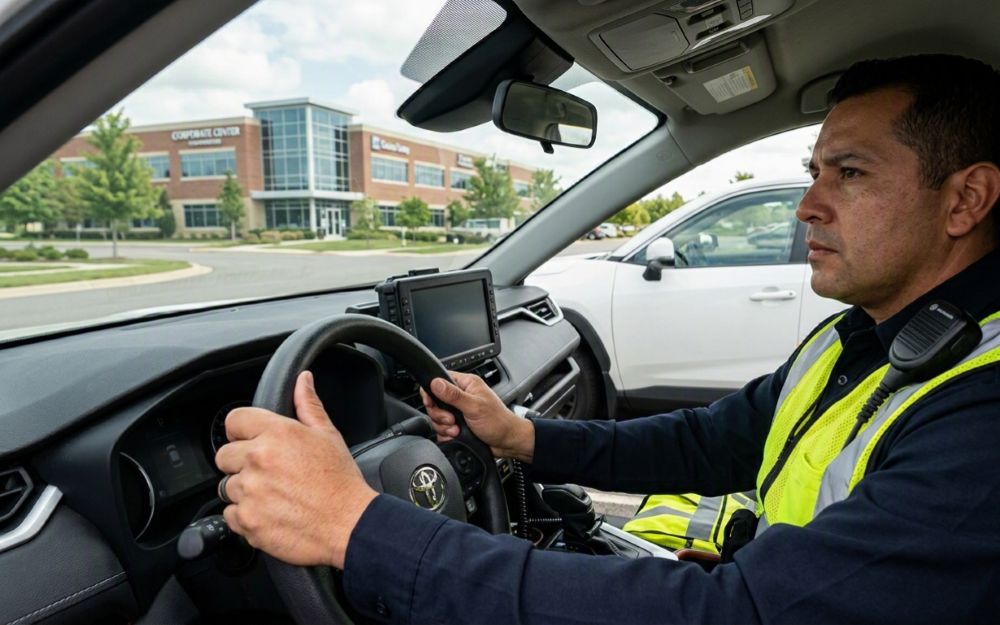
A standard mobile patrol shift operates in cycles:
1. Pre-Shift Briefing
The officer reviews the patrol assignment, notes any prior-shift incidents or client alerts, and confirms vehicle and equipment readiness.
2. Route Commencement
The officer begins the assigned route, varying timing and sequence across checkpoints per their training.
3. Checkpoint Verification
At each checkpoint, the officer physically verifies the status of the assigned inspection points and logs findings via digital reporting (GPS timestamp, written notes, photos if required).
4. Incident Response
If an alarm triggers or an incident is observed, the officer responds per escalation protocol: securing the scene, contacting law enforcement if required, and filing an incident report.
5. End-of-Shift Report
A comprehensive patrol log is generated and delivered to the client, covering all checkpoints, times, findings, and any incidents.
Mobile Patrol vs. Static Security Guards: Which Is Right for Your Business?
| Factor | Mobile Patrol | Static Guard |
| Coverage Area | Large or multiple locations | Single post or small area |
| Cost Efficiency | High (one officer covers more ground) | Lower (one officer per post) |
| Deterrence Type | Unpredictable, dynamic | Visible, consistent |
| Best For | Warehouses, retail parks, campuses | Lobbies, gates, single entry points |
| Response Capability | Rapid multi-point response | Immediate on-post response |
Many businesses use a hybrid model: static guards at critical access points with mobile patrol covering the broader perimeter and outlying areas.
Who Benefits Most from Mobile Patrol Security?
Commercial and Industrial Properties
Warehouses, distribution centers, and manufacturing facilities are strong candidates for mobile patrol security because they often have large perimeters, multiple access points, loading areas, and high-value inventory. Vehicle patrols help monitor exterior zones that fixed cameras or stationary guards may not fully cover.
Retail Parks and Shopping Centers
Retail parks and shopping centers benefit from after-hours patrols around parking lots, storefronts, loading docks, dumpsters, and exterior walkways. Regular patrol visibility can help deter vandalism, trespassing, vehicle break-ins, and unauthorized activity after stores close.
Construction Sites
Active construction sites are vulnerable to theft, trespassing, vandalism, and equipment damage, especially overnight. Mobile patrols provide a cost-effective security presence during off-hours without requiring a permanent on-site guard for the entire shift.
Multi-Location Businesses
Businesses with several sites across a metro area can use one mobile patrol provider to cover multiple locations under a single agreement. This helps standardize patrol schedules, incident reporting, escalation procedures, and security documentation across all properties.
Property Management Companies
Residential communities, HOAs, apartment complexes, and managed commercial properties can use mobile patrol services to provide documented oversight without hiring full-time security staff. Patrol officers can check gates, parking areas, amenity spaces, common areas, and exterior access points while reporting issues back to property managers.
How to Hire a Mobile Patrol Security Company
Step 1: Confirm State Licensing for Both Company and Officers
Mobile patrol officers must hold valid security guard licenses in their operating state. Companies must carry appropriate business licensing and liability insurance. Request copies before committing.
Step 2: Ask About GPS-Verified Patrol Logs
A quality provider tracks patrol routes via GPS and provides client-accessible logs confirming exact patrol times and checkpoint completion. If a company can’t provide this, their patrol documentation is unverifiable.
Step 3: Establish Alarm Response Time Expectations
Ask specifically: what is your average on-site response time for alarm activation at our property? This should be defined contractually, not just estimated verbally.
Step 4: Define the Reporting Protocol
How are incidents escalated? How quickly do you receive a report after an incident? What format does reporting take? These should all be answered in the service agreement.
Step 5: Evaluate Communication Infrastructure
Does the patrol officer have radio or cellular contact with a dispatch center throughout their shift? Can you reach a live supervisor during off-hours if needed?
Frequently Asked Questions
What is mobile patrol security?
Mobile patrol security is a service in which licensed security officers conduct vehicle-based patrols of assigned properties, performing scheduled and random checks, alarm response, incident reporting, and lock/unlock services.
How much does mobile patrol security cost?
Mobile patrol pricing varies by patrol frequency, coverage area, and service level. Basic patrol contracts typically range from $500 to $2,000+ per month depending on the number of patrol visits per night and the property size.
Is mobile patrol better than a security camera system?
They serve different functions. Cameras document what has happened; mobile patrol officers intervene, deter, and respond in real time. The most effective security programs use both together.
What does a mobile patrol security officer carry?
Standard equipment includes a radio or cellular device, flashlight, incident reporting tools (digital or written), and appropriate personal protective equipment. Armed patrol officers additionally carry a licensed firearm per state requirements.
Are mobile patrol officers the same as police officers?
No. Mobile patrol security officers are private security personnel, not law enforcement. They respond to property-level incidents, coordinate with police, and document findings, but they do not hold law enforcement authority.
Protect Every Corner of Your Property: Start Mobile Patrol Today
Static guards cover one position. Mobile patrol covers everything else. For businesses that need cost-effective, documented, and unpredictable security coverage across large or multiple properties, vehicle patrol is the professional solution.
Instaguard provides fully licensed mobile patrol security services with GPS-verified patrol logs, rapid alarm response, and experienced officers trained to protect commercial and residential properties across every shift.
Request a patrol assessment today.
READ MORE: Types of Security Patrols: Which One Is Right for Your Property?