
Table of Contents
The Short Answer: Most Hospital Security Guards Are Unarmed
Why Most Hospitals Choose Unarmed Security
What Hospital Security Guards Actually Carry
When Hospitals Do Use Armed Security
California Rules: BSIS Licensing and Exposed Firearm Permits
How Hospitals Decide Their Security Coverage Model
Armed vs. Unarmed Hospital Security: A Side-by-Side Look
Build a Hospital Security Model That Matches Your Facility’s Risk
Key Takeaways
- Most hospital security guards in the United States are unarmed. Industry data shows roughly 71% of hospitals have no plans to use firearms.
- Healthcare workers face workplace violence rates roughly five times higher than the private industry average, according to BLS data.
- Hospital security training emphasizes verbal de-escalation, not weapons handling.
- In California, armed security requires both a BSIS guard card and a separate Exposed Firearm Permit, with additional training and a psychological assessment.
- The choice between armed and unarmed is a facility-level risk decision, not an industry default.
Hospital security comes up most often after an incident makes the news, and the first question is almost always the same: are the guards armed?
For most hospitals in the United States, the answer is no. Healthcare facilities have leaned toward unarmed coverage for reasons tied to patient experience, liability, and the clinical environment itself. The picture is more layered than yes or no, though, and the right model depends on the facility, the patient population, and the documented risk profile.
The Short Answer: Most Hospital Security Guards Are Unarmed
The majority of US hospitals run unarmed security programs.
According to data summarized by the American Hospital Association’s Trustee Services, roughly 71% of hospitals surveyed have no plans to use firearms, while 15% arm only specific staff and 4% contract armed off-duty police officers. The remainder fall somewhere in between, often with armed coverage limited to a single facility, shift, or unit.
That distribution has shifted slowly over the past decade, but unarmed remains the standard model for general hospital security. Most officers patrolling a typical medical center, urgent care, or outpatient clinic do not carry a firearm.
Why Most Hospitals Choose Unarmed Security
The reasons are practical, not ideological.
Patient population
Hospitals serve children, elderly patients, people in active medical crises, and patients with behavioral health conditions. A visible firearm changes the dynamic in every one of those interactions. In pediatric and behavioral health units in particular, weapons can escalate the situation security is supposed to defuse.
De-escalation as the primary tool
OSHA’s Guidelines for Preventing Workplace Violence for Healthcare and Social Service Workers emphasizes verbal intervention, environmental design, and training as the first line of defense. Most hospital security officers carry de-escalation certifications such as CPI (Crisis Prevention Institute) or MOAB (Management of Aggressive Behavior) and rely on those skills daily.
Liability exposure
Discharge of a firearm inside a hospital carries severe legal, regulatory, and reputational consequences. Insurance carriers price armed programs differently, and many hospital boards weigh that math carefully.
Weapon retention risk
In behavioral health units, emergency departments, and forensic settings, the possibility of a patient in crisis attempting to disarm an officer is a real consideration. Some hospital security directors view that risk as reason enough to keep firearms out of the equation.
None of this means armed coverage is wrong. It means the trade-offs run in both directions.
What Hospital Security Guards Actually Carry
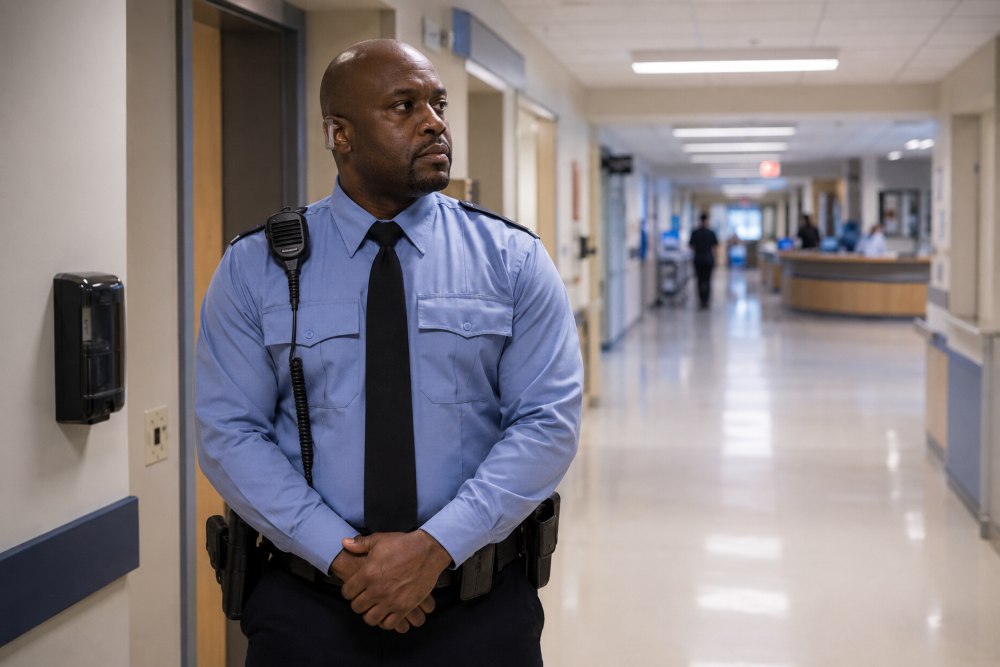
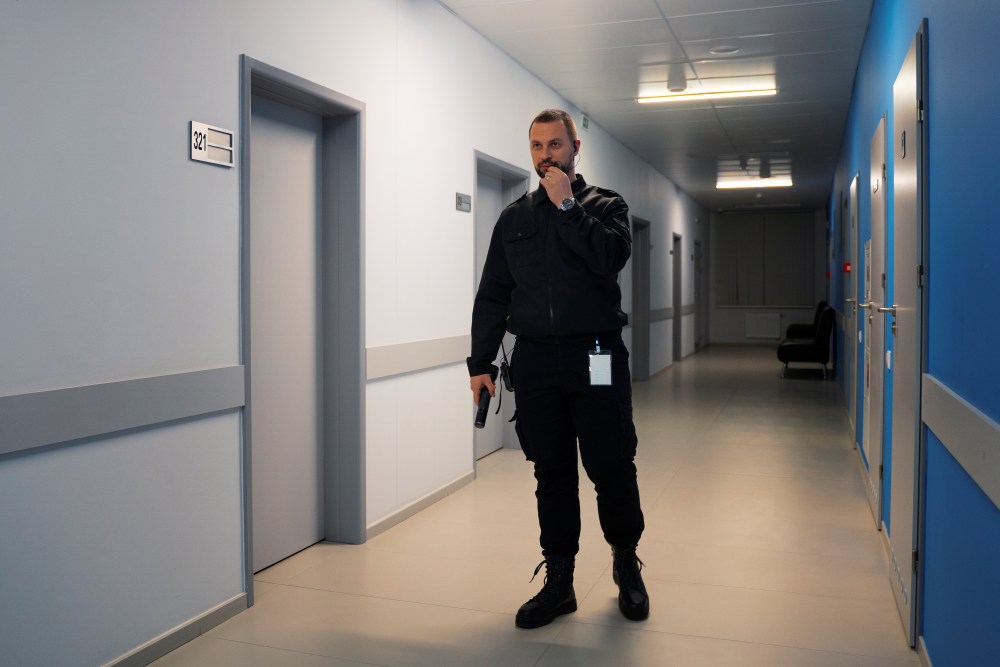
Most hospital security officers carry equipment focused on communication, identification, and documentation rather than force:
- Two-way radios for coordination with the security command, clinical staff, and outside responders
- Identification credentials and access cards
- Flashlights and notepads
- Handcuffs (in some programs, restricted to specific situations and trained officers)
- Body-worn cameras, which have grown more common in healthcare since 2020
- Duress alarms tied to the facility’s panic-button system
A smaller share carry intermediate-force tools such as OC spray, batons, or conducted electrical weapons (Tasers). Use of these tools is governed by facility policy and state regulation, and adoption varies widely by region and facility type.
The most important asset a hospital security officer brings is training. Effective hospital security relies on observation, communication, and timely response, not hardware.
When Hospitals Do Use Armed Security
Armed coverage exists in healthcare and has legitimate use cases. The most common scenarios:
- Level I trauma centers in urban environments with documented patterns of weapons-related incidents
- Hospitals with adjacent or onsite forensic, corrections, or psychiatric forensic units
- Facilities that contract off-duty law enforcement for specific high-risk windows
- Executive protection coverage for individual patients with elevated personal risk (rare and situational)
Armed coverage is a tool, not an upgrade. A hospital with an armed program still needs strong de-escalation training, well-defined use-of-force policy, written post orders, and rigorous officer vetting. Adding firearms without those foundations does not improve safety.
California Rules: BSIS Licensing and Exposed Firearm Permits
California regulates private security through the Bureau of Security and Investigative Services (BSIS), a division of the Department of Consumer Affairs. The licensing structure for hospital security in California follows the same framework that applies to other private security work, with additional requirements for armed officers.
For unarmed coverage, every guard must hold a current BSIS Security Guard Registration (commonly called a guard card). The current pathway includes Power to Arrest training, Appropriate Use of Force training, a Live Scan background check through the FBI and DOJ, and annual continuing education.
For armed coverage, the officer must hold a separate BSIS Exposed Firearm Permit in addition to the guard card.
According to BSIS, applicants must:
- Be at least 21 years old
- Be a US citizen or have permanent legal residency
- Pass a criminal history background check through the FBI and DOJ
- Pass the 16PF psychological assessment within the six months before applying
- Complete BSIS-approved firearms training and pass range qualification
- Qualify with the specific caliber listed on the permit
- Maintain the permit with four range qualifications across each two-year cycle
Hospitals contracting armed coverage from a private security company in California should verify both credentials are current, and that the issuing Private Patrol Operator (PPO) is licensed and in good standing with BSIS. Regulations may change, so confirm current requirements directly with BSIS.
How Hospitals Decide Their Security Coverage Model
The arm-or-not-arm question is the wrong starting point. A facility-level risk assessment is. The process most hospital risk managers and security directors follow looks roughly like this.
Step 1: Conduct a site-specific security risk assessment
Cover facility layout, patient population, ED volume, behavioral health capacity, neighborhood context, parking and perimeter, and historical incident data. The site-specific assessment is the foundation; everything downstream depends on it.
Step 2: Review workplace violence data for the facility and unit
The Bureau of Labor Statistics reports that healthcare workers experience a workplace violence injury rate roughly five times the all-industry average, and the healthcare and social assistance sector accounts for approximately 73% of all nonfatal workplace violence injuries that require days away from work. Review the data at the unit level, not just the industry level. Behavioral health, ED, and L&D often look very different from general med-surg.
Step 3: Align with IAHSS healthcare security industry guidelines
The International Association for Healthcare Security and Safety publishes voluntary standards that serve as the gold standard for healthcare facility safety. Major accreditation bodies reference these requirements during facility reviews.
Step 4: Coordinate with clinical leadership, patient safety, and legal
Security decisions touch every department. Unilateral choices made by security or facilities alone do not hold up well in post-incident review.
Step 5: Match personnel, training, and equipment to the assessed risk
Different units inside the same hospital may warrant different coverage models. The same facility may run unarmed officers in pediatrics and a different protocol in the ED.
Armed vs. Unarmed Hospital Security: A Side-by-Side Look
| Coverage Model | Best Fit | Trade-off |
| Unarmed uniformed officers | General hospital coverage, lobby and access control, routine patrol | Lower liability profile, lower deterrence against weapons incidents |
| Unarmed with de-escalation and CPI training | Behavioral health, ED, pediatrics | Strong clinical-environment fit, requires ongoing training investment |
| Armed licensed security (BSIS Exposed Firearm Permit in CA) | Specific high-risk facilities or scenarios | Higher cost, higher liability exposure, rigorous vetting required |
| Off-duty law enforcement | Supplemental coverage for events or high-risk windows | Different legal authority, different chain of command, different cost structure |
Build a Hospital Security Model That Matches Your Facility’s Risk
The honest answer to “do hospital security guards have guns?” is that most do not, and the decision should follow the risk assessment, not precede it. Healthcare environments are clinical environments first. Security exists to support patient care and staff safety, not to overwrite either one.
Instaguard Security has staffed healthcare and other high-compliance environments across Los Angeles County and California since 2008. Our officers are BSIS-licensed, trained for the assigned environment, and supported by written post orders and reporting. Free risk assessments are available for hospitals and clinical facilities evaluating their security model.
Frequently Asked Questions
Are most hospital security guards armed?
No. According to industry survey data summarized by the American Hospital Association, roughly 71% of US hospitals have no plans to use firearms. Armed coverage is most common at specific high-risk facilities, not as a general standard across healthcare.
Can hospital security guards carry guns in California?
Yes, but only with a BSIS Exposed Firearm Permit in addition to their guard card. Officers must be at least 21, pass the 16PF psychological assessment, complete BSIS-approved firearms training, and re-qualify on the range four times during each two-year permit cycle.
What do unarmed hospital security guards actually do?
Access control, patrol, incident response, verbal de-escalation, escorting clinical staff, supporting workplace violence prevention protocols, and coordinating with local law enforcement when criminal incidents occur.
What training do hospital security officers receive in California?
Beyond the BSIS guard card training (Power to Arrest and Appropriate Use of Force), most hospital security officers complete de-escalation training such as CPI or MOAB, plus facility-specific training on HIPAA, restraint policy, and emergency codes. Armed officers complete additional firearms training and qualification.
Who regulates hospital security in California?
Private security personnel are licensed by BSIS, part of the California Department of Consumer Affairs. Hospitals themselves are regulated by the California Department of Public Health and federal agencies depending on the service line. Regulations may change, so confirm current requirements directly with BSIS.