

Table of Contents
Do Hotels Have Security Guards? What Most Property Managers Get Wrong
What Does a Hotel Security Guard Actually Do?
What Types of Security Guards Do Hotels Need? A Comparison by Property Profile
How Do You Build a Hotel Security Plan? A Step-by-Step Guide for Property Managers
Frequently Asked Questions About Hotel Security Guard Services
Who Provides Licensed Hotel Security Guard Services in Los Angeles?
Hotel security guard services are contracted, licensed security deployments specific to a hotel property, event, or shift. The services cover guest safety, access control, incident response, and perimeter coverage. Every officer working in California must hold an active Bureau of Security and Investigative Services (BSIS) guard card. Hotels that hire unlicensed personnel shift incident liability to the property operator, not the vendor.
Quick Summary: Key Takeaways
- Hotel security guards vs. loss prevention vs. in-house staff: three distinct roles, each with separate accountability and scope
- BSIS licensing: the mandatory California credential every private security officer must hold before working any hotel post
- Risk assessment first: guard count and coverage type cannot be accurately determined without a site-specific assessment
- Written post orders: the documentary standard that protects the hotel during insurance and liability review
- 8-to-12-week lead time: the recommended advance booking window for hotels hosting public-facing events in Los Angeles County
Do Hotels Have Security Guards? What Most Property Managers Get Wrong
Most hotels have some form of security presence, but many property managers assume in-house staff or a loss prevention team is sufficient. In most California hotel operations, contracted licensed security is a separate and necessary layer.
The three roles serve different functions:
- In-house hotel security: Hotel employees focused on general oversight, guest relations, and property policy enforcement
- Loss prevention officers: Focused on internal theft, asset shrinkage, and inventory investigation
- Contracted private security guards: Licensed through the BSIS, accountable to a written contract, and responsible for guest safety, access control, and incident response
OSHA identifies hospitality as a sector with elevated workplace violence risk, citing service workers in hotels and entertainment venues as a regularly affected group. Insurance carriers and venue contracts in California increasingly require documented security planning before confirming coverage or issuing final permits.
What Does a Hotel Security Guard Actually Do?
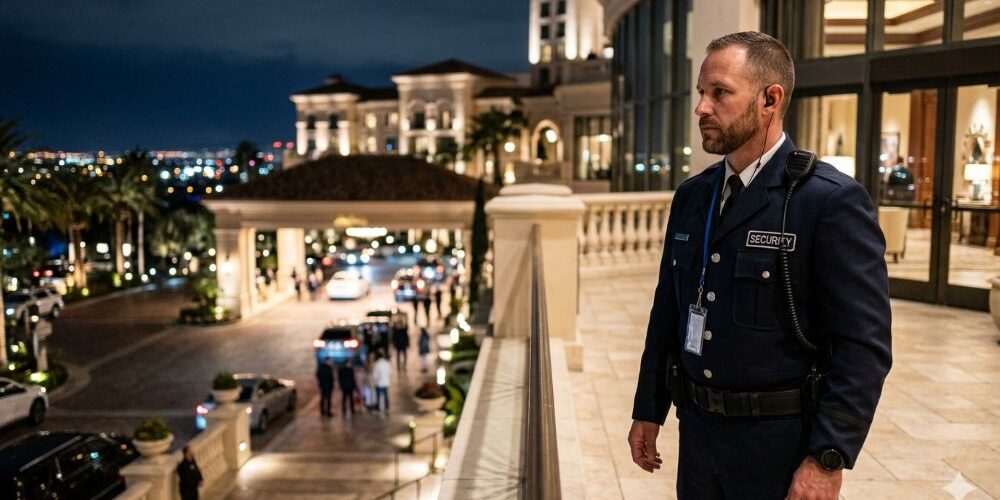
Hotel security guards manage access control, incident response, perimeter coverage, and guest safety across multiple zones simultaneously. Each officer’s responsibilities are defined by post orders: written, property-specific instructions completed before the first shift.
Core responsibilities across a hotel property:
- Credential and ID verification at entry points and access-restricted areas
- Guest dispute de-escalation in lobbies, amenity areas, and room floors
- Vehicle circulation oversight and theft deterrence in parking structures
- Crowd management and alcohol service monitoring at pools, bars, and events
- Vendor credentialing and access control at back-of-house and loading docks
- Perimeter control, crowd flow management, and evacuation support in event spaces
What Types of Security Guards Do Hotels Need? A Comparison by Property Profile
The right hotel security guard mix depends on property footprint, guest volume, event programming, and risk profile. A site-specific risk assessment determines the correct guard type and count before any staffing decision is finalized.
| Guard Type | Best Fit | Key Trade-Off |
| Unarmed uniformed guards | Boutique hotels, mid-scale properties, daily lobby coverage | High-visibility deterrence, lower cost; not suited for elevated threat profiles |
| Static plus mobile hybrid | Full-service hotels, resort properties, multi-floor layouts | Balances fixed-post coverage with floor patrol response; most common model |
| Vehicle patrol | Extended parking, large resort footprints, off-site lots | Covers scale efficiently; officers are not stationed at fixed posts |
| Executive protection officers | High-profile guests, celebrity or dignitary stays | Close-proximity trained coverage; higher per-officer cost |
When Does a Hotel Need Armed Security Guards Instead of Unarmed Officers?
Armed hotel security is appropriate for specific, documented, elevated-risk situations. Armed coverage is not a standard upgrade for any hotel category.
Armed coverage is generally appropriate when:
- Significant cash handling or high-value asset transfers occur on the property
- Credible, documented threat intelligence exists for a specific guest or event
- Local law enforcement response times are a verified operational concern
California law requires armed security officers to hold a separate BSIS exposed firearm permit in addition to a standard guard card. Both credentials must be active before an armed officer works any post. For the majority of hotel properties across Los Angeles County, unarmed uniformed guards are the appropriate model.
*California licensing requirements may change. Confirm current armed guard requirements directly with BSIS before deployment.

How Do You Build a Hotel Security Plan? A Step-by-Step Guide for Property Managers
A hotel security plan is a written, site-specific document covering risk, coverage zones, post orders, communications, and emergency response. Building one correctly follows this sequence.
Step 1: How Do You Run a Site-Specific Risk Assessment for a Hotel Property?
A site-specific risk assessment is the foundation for every downstream decision. Guard count, coverage type, and emergency routing cannot be determined accurately without completing this step first.
A complete hotel risk assessment covers:
- Venue layout: ingress and egress points, emergency exits, stairwells, and service corridors
- Guest volume and composition: occupancy levels, VIP presence, event programming, and alcohol service
- Cash handling locations, high-value asset storage, and time-of-day risk patterns
- Existing hotel emergency protocols, AED locations, and nearest medical resources
The assessment produces a ranked threat profile, a recommended guard count and post map, a communications plan, and an emergency action plan tied to the hotel’s existing protocols.
Step 2: How Do You Define Coverage Zones and Written Post Orders for Hotel Security?
Coverage zones map every area of the hotel to a specific guard post. Post orders define exactly what each officer does at that post, in writing, before the first shift begins.
Post orders must include:
- Assigned location, shift boundaries, and reporting chain
- Authorized actions, scope limits, and escalation triggers
- Full emergency contact tree: hotel management, local LAPD precinct, LAFD, and EMS
Post orders are the documentary record that protects the hotel during insurance and liability review. A deployment without written post orders has no accountability standard.
Step 3: How Do You Coordinate Hotel Security With Local Authorities and the Venue?
Private hotel security supplements LAPD, LAFD, and EMS. Private security does not replace public emergency services.
Before the first shift, coordination must establish:
- A single named on-site supervisor as the contact point for all contracted vendors (front desk, AV, catering, valet)
- A shared radio channel or communications protocol across all hotel departments
- Confirmed locations of exits, AED units, and nearest medical resources
For hotels in the City of Los Angeles hosting public-facing events, the Special Events Permit Office may require coordination with LAPD, LAFD, or the Bureau of Street Services. Pasadena, Long Beach, Santa Monica, and Burbank each operate independent permit processes. Confirm all permit conditions early; permit reviewers do not move on the organizer’s timeline.
Step 4: How Do You Match Technology to Your Hotel Security Guard Deployment?
Technology supports hotel security officers on post. Technology does not replace trained, licensed personnel.
- Body-worn cameras: post documentation and officer accountability throughout each shift
- Credential scanning: access control at ticketed or badged hotel events
- Real-time radios: required for all multi-zone deployments with more than one active post
Technology selection follows the risk assessment output. A vendor recommending specific tools before completing an assessment is running the planning sequence in the wrong order.
Step 5: What Reporting and Documentation Should Hotels Require After Every Shift?
The 30-to-90-day window after an event or shift cycle is when insurance questions and incident claims most commonly surface. Shift documentation is the hotel’s primary protection during that window.
Require from any hotel security provider:
- Real-time incident logs with timestamps during every shift
- Written daily activity reports for multi-night or event-period coverage
- A written post-event summary delivered within 48 hours of event close
- Records retained for the full insurance and liability review window
Require post-shift documentation as a written contract term before any security services agreement is signed.

Frequently Asked Questions About Hotel Security Guard Services
Do Hotels Have Their Own Security Guards, or Do They Hire Outside Companies?
Both models exist. Some large hotel chains employ in-house security staff directly. Many properties contract licensed private security companies for event coverage, overnight shifts, or full-time deployment. Contracted guards are accountable to the hotel through a written agreement and must hold active BSIS credentials.
How Many Security Guards Does a Hotel Need?
No universal staffing ratio applies to all hotel types. Guard count depends on property footprint, number of floors, guest volume, event programming, alcohol service, and risk profile. A site-specific risk assessment is the only accurate method. Instaguard provides guard count recommendations as part of every free consultation.
What Is the Difference Between Hotel Security and Loss Prevention?
Loss prevention officers focus on internal theft, asset shrinkage, and inventory investigation. Hotel security guards focus on guest safety, access control, incident response, and perimeter coverage. The two roles serve distinct functions and one does not substitute for the other.
How Much Do Hotel Security Guard Services Cost in Los Angeles?
Hotel security pricing in LA County is not a flat rate. Cost depends on guard type, total coverage hours, property footprint, risk profile, and any city permit coordination requirements. Instaguard provides written, itemized quotes within one business day of a free consultation.
Are Hotel Security Guards in California Required to Be Licensed?
Yes. All private security personnel in California must hold an active BSIS guard card, requiring fingerprinting, background checks, and mandatory training hours. Armed officers must additionally hold a separate BSIS exposed firearm permit. Hiring unlicensed personnel shifts liability to the hotel operator. Confirm current requirements at bsis.ca.gov.
Who Provides Licensed Hotel Security Guard Services in Los Angeles?
Instaguard Security has staffed licensed security deployments across Los Angeles County and California since 2008. Instaguard is BSIS-licensed, fully insured, and assigns vetted, trained officers across unarmed coverage, vehicle patrol, and executive protection.
- Free site-specific risk assessment tied to the hotel’s actual property layout, guest profile, and event timeline, not a default staffing package
- Written, itemized quote within one business day reflecting actual officer count, coverage hours, and post assignments for the specific property
- Named on-site supervisor for every deployment, managing all coverage zones and vendor coordination from setup through post-shift reporting
This content is for informational purposes only and is not legal, insurance, or compliance advice. California security licensing requirements and regulations may change. For a tailored security assessment or to confirm current service options, contact Instaguard Security.